Stepping into that cave is not merely a descent into rock and shadow… it is a passage into a buried memory—where time itself seems to have been held in place, silent, cold, yet never truly gone. Shanidar Cave is not just a hollow in the mountains of Iraqi Kurdistan. It feels more like a threshold—opening onto a world from 65,000 years ago, where ancient humans left behind traces… and perhaps, secrets that have never been fully told.
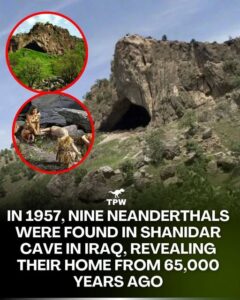
In the 1950s and 1960s, archaeologist Ralph Solecki led excavations within its depths. But what he uncovered was more than bone. It was a silent assembly—nine Neanderthal individuals, later named Shanidar 1 through Shanidar 9—resting within the stone as if preserving a story without words. These remains shattered the long-held image of Neanderthals as crude and primitive. Some bore signs of severe injuries, yet had lived on… suggesting that someone had cared for them. In the darkness of prehistory, did compassion already exist?

But what makes Shanidar Cave truly haunting… is Shanidar 4.
Beside this skeleton, traces of pollen were discovered. A theory quickly spread across the world: a “flower burial”—a ritual farewell to the dead. Imagine it… tens of thousands of years ago, in a harsh and unforgiving landscape, ancient humans placing flowers beside the fallen. A gesture symbolic, almost sacred. Yet doubt soon followed. Later research suggested that the pollen may have been carried in by burrowing animals. And so the question lingers in the dark: was it a ritual… or merely a cold coincidence of nature?

More recent excavations—especially the discovery of a new individual known as Shanidar Z—have only deepened the mystery. This cave was not used just once, nor by chance. It was returned to. Again and again, across thousands of years, Neanderthal groups came back to this same shelter. As if the cave was not just a refuge… but something remembered.

Something strange lies hidden within those layers of sediment. Long gaps of absence… followed by signs of return. Who remembered this place? And how—when their world held no maps, no written words?

Shanidar Cave still stands in the rugged Zagros Mountains—a silent witness. Yet the more we uncover, the clearer it becomes: Neanderthals were never as simple as we once believed. They endured, adapted, cared for one another… and perhaps carried memories across generations.
The truth is—we have only begun to read a fragment of their story.
The rest… still waits in the dark.