Picture a wooden sailing ship — hull, masts, a fortune in its belly — lying half-buried in the sand of one of the driest deserts on Earth, far from any harbor. It sounds impossible, as if the sea had reached inland and abandoned a galleon in the dunes.
In Namibia, it’s real. A roughly 500-year-old ship, heavy with gold, ivory and copper, was found resting in the sand of the country’s forbidden diamond coast. But how it got there isn’t quite the romantic tale the photos suggest — and the truth is, if anything, even better.

The day the miners drained the sea
The discovery came in 2008, on the southern coast of Namibia near the town of Oranjemund — deep inside the Sperrgebiet, the restricted zone where the Namib Desert runs straight into the cold Atlantic.
Workers for the De Beers / Namdeb diamond operation were doing what they always do here: pushing back the ocean. To reach the diamond-rich gravels near the shoreline, they had thrown up a wall against the sea and pumped the water out of a pocket of coast roughly 200 meters across.
When the water was gone and the sand was scraped down, something appeared that no one had been mining for. Timbers. Then copper ingots. Then elephant tusks. A De Beers worker had stumbled onto the remains of an ancient ship — not by digging into the desert, but by emptying a piece of the sea.
The richest wreck on the coast
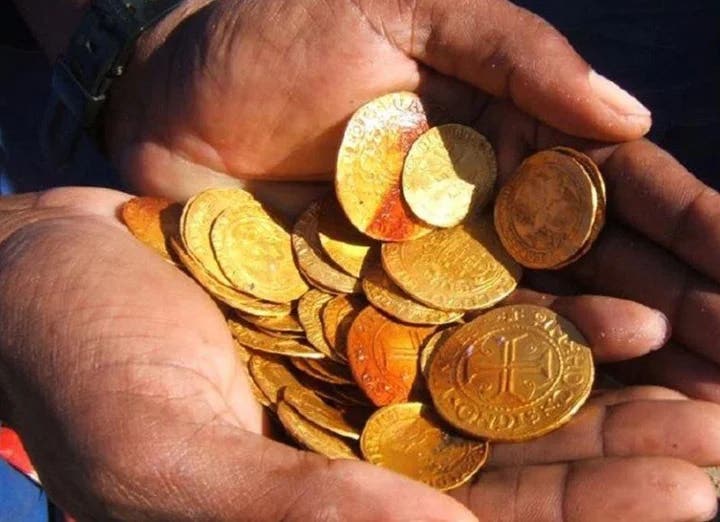
What came out of that sand made headlines around the world. Archaeologists, brought in to take over the site, recovered an astonishing haul: reportedly around 1,845 copper ingots weighing some 16 to 17 tons, more than 2,000 gold and silver coins, and over 100 elephant tusks — close to two tons of ivory. Alongside them came swords, muskets, cannons, bronze and pewter vessels, and navigational instruments.
The coins alone were extraordinary — struck by several different European powers, a glittering snapshot of 16th-century international finance carried inside a single hull. Researchers describe it as the oldest and most valuable shipwreck ever found off the western coast of sub-Saharan Africa.
It wasn’t a ship that sailed into the desert. It was a ship the sea and the sand hid together for half a millennium.
So how did a ship end up in the sand?
Here it pays to be honest, because the popular version — that shifting dunes or a retreating coastline carried a ship miles inland — isn’t really what happened.
The Namib coast itself is desert; the dunes meet the surf. The ship didn’t travel inland. It wrecked right here on the shore, most likely driven aground by a storm, and over the centuries the relentless coastal sand and the bone-dry climate simply swallowed and preserved it where it lay, just beyond the waterline.
It stayed hidden not because the land moved, but because this is one of the most remote, forbidden, and barely-touched coastlines on the planet — and because, in 2008, people happened to pull the ocean back and look underneath. The dry sand did the rest. In a wetter place, the wood and iron would have rotted to nothing. Here, the desert acted like a vault.

A ship with a name
The wreck has been identified, researchers believe, as the Bom Jesus — “the Good Jesus” — a Portuguese nau that reportedly set sail from Lisbon on 7 March 1533, under a captain recorded as Francisco de Noronha, bound for the riches of India around the tip of Africa.
It never rounded the Cape. Somewhere off the southwest African coast it was lost — and for nearly five centuries it vanished from history, one of many ships the dangerous India route swallowed whole. Its cargo tells you exactly what was at stake: a vessel loaded with coined wealth and trade metal, sailing the long, deadly sea road that was making 16th-century Europe rich.
What the wreck still tells us
Beyond the gold, the Bom Jesus is a time capsule of the Age of Discovery. Its coins map the web of powers financing these voyages. Its copper and ivory trace the goods moving between continents. Its instruments and weapons show how sailors navigated — and armed themselves — on routes that were still being drawn on the map.

And some questions stay open. The fate of the crew, above all: it isn’t clear how many, if any, survived the wreck on that hostile shore. The men who sailed her vanished even more completely than the ship.
Today the treasure is held in Namibia — gold coins reportedly secured in a bank vault in the capital, Windhoek, and artifacts displayed in a museum at Oranjemund — a 16th-century fortune that spent 500 years under the sand of a diamond coast.
So here’s the thought to sit with: if a treasure ship could lie hidden for five centuries just beyond the surf, found only because miners drained the sea — how much more history is still out there, waiting under sand and water for someone to look in exactly the right place?