What if the oldest stories ever told were never written down at all? What if they were painted onto stone walls using pigments made from earth, charcoal, and minerals—and some of those images appear to show creatures that disappeared thousands of years before recorded history began?

Across caves, cliffs, and hidden rock shelters around the world, ancient artists left behind remarkable scenes that continue to puzzle archaeologists. Some paintings seem straightforward. Others raise questions that remain surprisingly difficult to answer. And that is where the mystery begins.
The First Storytellers of Humanity
Long before cities, kingdoms, or written language existed, humans were already creating art. Archaeological discoveries have revealed prehistoric paintings dating back tens of thousands of years.

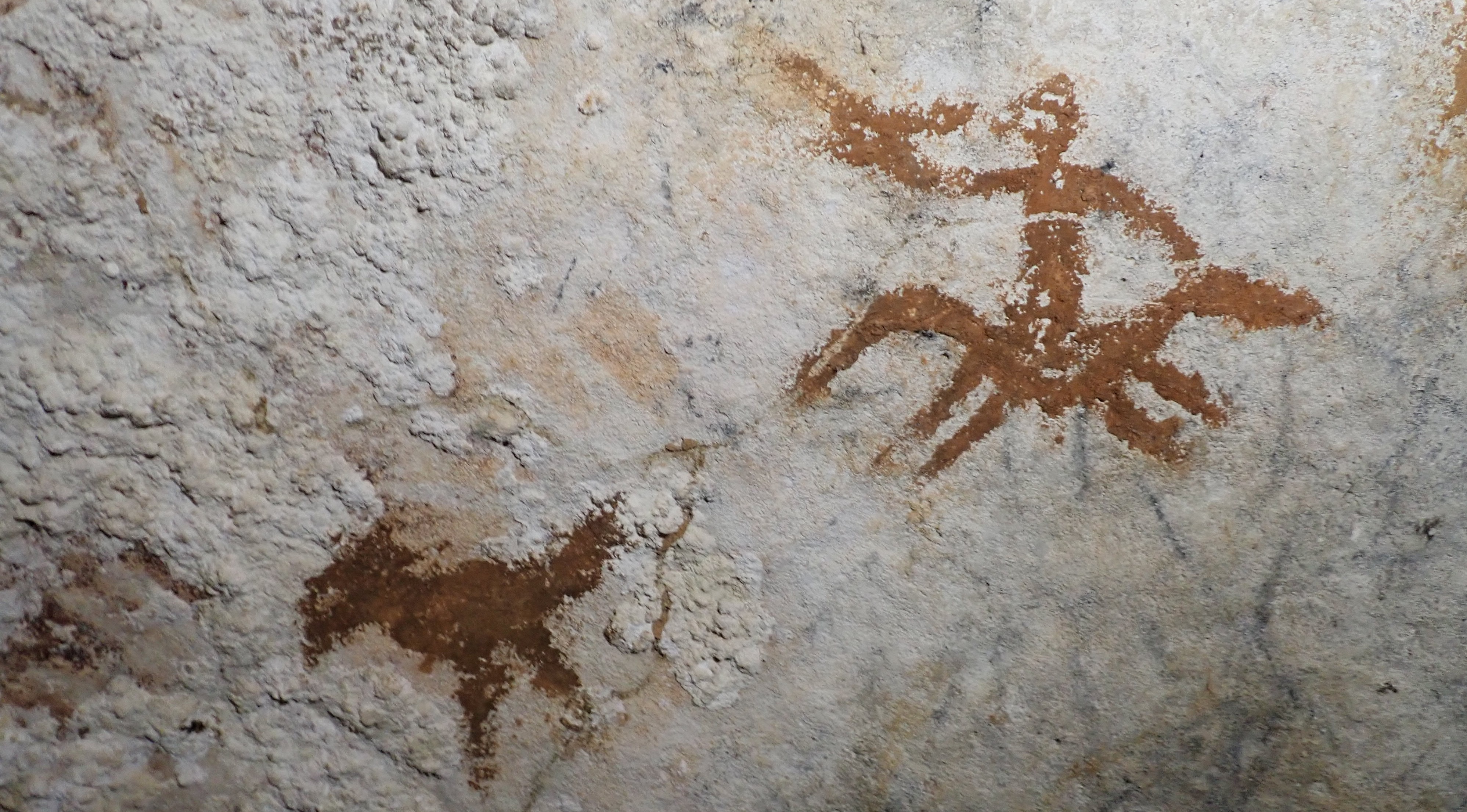
These artworks appear in caves across Europe, Africa, Asia, Australia, and the Americas. They depict animals, hunting scenes, symbols, handprints, and occasionally figures whose meaning remains uncertain.
For many researchers, these paintings represent some of humanity’s earliest attempts to record experiences, communicate knowledge, and preserve memories.
But not every image fits neatly into that explanation.
What Archaeologists Know About Ancient Rock Art
Painted With the Earth Itself
Ancient artists used natural materials found in their surroundings.
- Red pigments often came from iron-rich ochre.
- Black colors were created using charcoal or manganese.
- White pigments could be made from clay or crushed minerals.
The techniques varied from simple finger painting to sophisticated brushes and spray methods.
Some sites reveal artistic traditions that continued for thousands of years.
A Window Into Prehistoric Life
Many paintings clearly depict animals that lived alongside ancient humans. Bison, horses, deer, mammoths, and other species appear frequently.
These images provide valuable clues about environments that existed long before written records.
Yet certain artworks seem to show animals that researchers continue to debate.
The Creatures That Spark Endless Questions
Some prehistoric images have attracted attention because they appear unusually detailed or difficult to identify.
At first glance, many can be explained as known animals viewed from unusual angles. However, others have inspired decades of discussion.
Could ancient artists have been recording species that later disappeared?
Or are modern viewers simply interpreting the images through contemporary assumptions?
The answer is not always obvious.
Extinct Animals Preserved in Art
There are examples where rock art appears to depict animals now extinct in particular regions. In some cases, archaeological evidence confirms humans and those animals lived during the same period.
Mammoths, giant deer, and other Ice Age creatures have been identified in several prehistoric artworks.
These discoveries demonstrate that ancient art can preserve visual information about species that vanished long ago.
But that is only part of the story.

The Questions Researchers Still Debate
Literal Observation or Symbolic Meaning?
One major challenge is determining whether an image was intended as a realistic depiction.
Ancient artists may have combined features from multiple animals. Some figures could represent myths, spiritual beliefs, or symbolic ideas rather than actual creatures.
This makes interpretation difficult.
What appears obvious today may have meant something entirely different to the people who created it.
The Problem of Time
Dating rock art is often complicated.
While scientists have developed increasingly advanced techniques, not every painting can be dated precisely. Sometimes archaeologists know the approximate age of a site but not the exact moment an image was created.
That uncertainty leaves room for competing interpretations.
Competing Theories Behind the Mysterious Images
Mainstream Archaeological Interpretation
The most widely accepted view is that prehistoric artists painted animals they observed in their environment, combined with symbolic imagery connected to culture and belief systems.
Under this interpretation, unusual figures are often explained through artistic style, incomplete preservation, or symbolic representation.
Memory Across Generations
Another hypothesis suggests that some images may preserve cultural memories passed down through generations.
Communities could have remembered encounters with species that later became rare or disappeared.
Oral traditions are capable of preserving information for remarkably long periods.
Could some paintings reflect those memories?
Alternative Speculations
More controversial interpretations occasionally claim that certain images depict creatures unknown to science or beings from legends.
However, these ideas generally lack strong archaeological evidence and remain speculative.
Most researchers caution against drawing extraordinary conclusions without equally extraordinary proof.
Evidence Hidden in Stone
Modern technology has transformed the study of ancient art.
Researchers now use digital imaging, 3D scanning, chemical analysis, and advanced photography to reveal details invisible to the naked eye.
In some cases, faded paintings once thought lost have reappeared through scientific analysis.
And then archaeologists discovered something unexpected.
Many sites contain multiple layers of paintings created over centuries or even millennia. What appears to be a single image may actually contain several generations of artistic activity.
This complexity often changes how researchers interpret mysterious figures.
Why This Mystery Still Matters Today
Ancient rock art is more than a collection of old paintings.
It represents direct communication from people who lived thousands of years ago.
These artists left clues about how they saw the world, what animals surrounded them, and what stories mattered most.
Every new discovery adds another piece to a puzzle that remains far from complete.
Yet one question still remains: how much knowledge from humanity’s earliest chapters is still hidden beneath layers of stone, dust, and time?
Modern Discoveries Continue to Rewrite History
New archaeological finds regularly push back the timeline of human creativity.
Sites once believed to be the oldest are sometimes surpassed by newly discovered artworks.
Improved dating methods continue to refine our understanding of when ancient people created these images.
Each breakthrough reveals that prehistoric societies were often more sophisticated than earlier generations imagined.
And with every discovery, the mystery deepens rather than disappears.
Final Thoughts
The world’s oldest stories may not be found in libraries or ancient manuscripts. They may exist on cave walls, hidden beneath mineral deposits, waiting for modern science to uncover them.
Some paintings clearly document real animals and real experiences. Others remain open to interpretation.
That balance between evidence and mystery is precisely what makes prehistoric rock art so fascinating.
Thousands of years later, those silent images continue to ask questions that humanity has not fully answered.
What Readers Are Saying
- Michael Turner: “I’ve read about prehistoric art before, but this made the mystery feel completely new.”
- Emily Carter: “The idea that ancient paintings could preserve forgotten memories is fascinating.”
- David Brooks: “I couldn’t stop reading once the discussion about extinct animals began.”
- Sarah Mitchell: “It’s amazing how much we still don’t know about our earliest ancestors.”
- Ryan Cooper: “The balance between science and mystery was exactly what I was looking for.”
- Jessica Lane: “Now I want to learn more about cave art around the world.”
- Thomas Reed: “The section on modern technology revealing hidden paintings was incredible.”
- Olivia Bennett: “History becomes much more exciting when you realize how many questions remain unanswered.”
Frequently Asked Questions
Is there evidence that prehistoric paintings depict extinct animals?
Yes. Some rock art appears to show species such as mammoths and other Ice Age animals that are known from archaeological evidence.
How old are the oldest known cave paintings?
Some examples are more than 40,000 years old, although discoveries continue to refine these estimates.
Why is interpreting ancient rock art so difficult?
Researchers often lack written explanations, and many images may contain symbolic meanings that are no longer understood.
Has modern technology changed our understanding of prehistoric art?
Absolutely. Advanced imaging techniques have revealed hidden details, faded paintings, and previously unknown layers of artwork.
Do archaeologists believe these paintings are historical records?
Some likely record real observations, while others may represent rituals, beliefs, stories, or symbolic concepts.
Can visitors see prehistoric rock art today?
Many sites are open to visitors, although access is often restricted to protect fragile paintings from damage.