Some archaeological discoveries are remarkable not because of their size, but because they challenge what we think we know about ancient cities. Hidden within the ruins of Kibyra lies a structure so unusual that it continues to fascinate historians and archaeologists alike.
At first glance, it appears to be a simple pool. Yet its design suggests a far more intriguing purpose—one that reveals surprising details about daily life, commerce, and engineering in the Roman world.

A Curious Structure Along a Busy Ancient Street
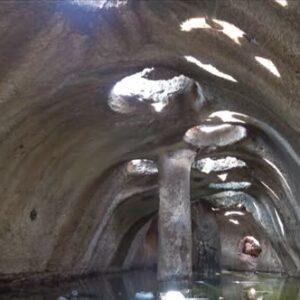
Located in the ancient city of Kibyra, in present-day southwestern Turkey, the Macellum occupies a strategic position on the first terrace of the city’s Agora Street.
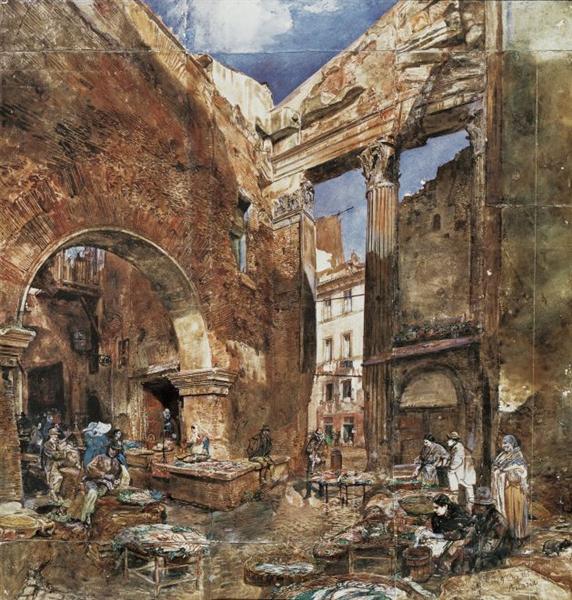
In Roman cities, a macellum was typically a marketplace where food products, especially meat and fish, were sold. These markets often featured enclosed spaces, shops, and central courtyards designed to support urban trade.
But Kibyra’s example is different.
Rather than following the standard architectural model seen elsewhere in the Roman world, this structure incorporates a small water basin directly into the streetside environment. That unusual feature has sparked considerable interest among researchers.

The Marketplace That Worked Like a Living Aquarium
More Than a Typical Roman Market
Archaeological evidence suggests that the pool was likely used for keeping live fish before sale. If correct, the structure represents a highly practical solution for preserving freshness in an era without refrigeration.
Imagine walking through a bustling ancient marketplace where fish remained alive in clear water until the moment of purchase. Such a system would have offered both convenience and quality to customers.
But that’s only part of the story.
An Urban Design Unlike Most Others
The integration of water management directly into a commercial space demonstrates sophisticated planning. The pool was not an isolated feature; it formed part of a larger urban landscape connected to roads, terraces, and public activity.
This combination of commerce and hydraulic engineering is one reason the structure stands out among Roman-era archaeological discoveries.

What Archaeologists Know Today
Researchers generally agree on several important facts:
- The structure is located along Kibyra’s Agora Street.
- Its architectural layout differs from many traditional Roman macella.
- The basin was intentionally designed to hold water.
- Its location suggests a direct connection to commercial activity.
- The most widely accepted interpretation links it to the sale of live fish.
These conclusions are based on archaeological investigation, architectural analysis, and comparisons with known Roman market practices.
Yet some questions remain unanswered.
The Questions Historians Still Debate
Was It Exclusively a Fish Market?
The leading interpretation identifies the structure as a specialized fish-selling area. However, some researchers have explored whether it may have served additional functions.
Could it have been used for temporary storage of other aquatic products? Was it connected to broader water-management systems within the city?
The available evidence strongly supports a commercial purpose, but not every detail has been fully reconstructed.
A Symbol of Prosperity?
Another possibility is that the pool also carried a symbolic dimension. Fresh fish was often associated with wealth and access to regional trade networks.
If so, the structure may have represented more than practical infrastructure. It could have showcased the city’s economic strength and organizational sophistication.
These interpretations remain hypotheses rather than established facts.
Evidence Hidden in the Architecture
One of the most compelling aspects of the site is how much information is preserved in the design itself.
The basin’s placement, construction techniques, and relationship to surrounding urban features suggest careful planning rather than later modification.
Archaeologists often learn as much from spatial relationships as from artifacts. In Kibyra, the arrangement of streets, terraces, and commercial areas provides important clues about how residents interacted with the marketplace.
And those clues continue to generate new questions.
Why This Discovery Still Matters
Ancient history is often told through emperors, wars, and monumental buildings. Yet structures like the Kibyra Macellum reveal something equally important: how ordinary people lived.
What did they eat?
How did merchants preserve food?
How were marketplaces organized?
Answering these questions helps historians reconstruct everyday life with greater accuracy.
The site also demonstrates that innovation was not limited to massive monuments. Even relatively small structures could incorporate advanced engineering concepts tailored to local needs.
Modern Research and New Perspectives
Recent archaeological work at Kibyra has expanded understanding of the city’s urban planning, public architecture, and commercial systems.
Advances in surveying technology, digital mapping, and architectural analysis allow researchers to study ancient infrastructure with greater precision than ever before.
Each new investigation helps place the Macellum within a broader picture of how the city functioned.
Yet despite these advances, some details remain elusive.
Exactly how the water circulated, how frequently fish were supplied, and whether similar structures once existed elsewhere are questions that continue to inspire research.
And that lingering uncertainty is part of what makes archaeology so captivating.
Final Thoughts
The Macellum of Kibyra may not be among the largest archaeological discoveries of the ancient world, but it offers a rare glimpse into the ingenuity of Roman urban life.
Its unusual combination of marketplace and hydraulic infrastructure highlights the practical creativity of ancient engineers while revealing the complexities of everyday commerce.
Thousands of years later, a seemingly modest pool still challenges assumptions and sparks curiosity.
Sometimes history’s most fascinating mysteries are not hidden inside grand palaces or towering temples. Sometimes they wait quietly beside an ancient street, preserving stories that have yet to be fully understood.
What Readers Are Saying
- Michael Turner: “I had never heard of this site before. The connection between engineering and commerce was fascinating.”
- Emily Carter: “It’s amazing how a small structure can reveal so much about ancient daily life.”
- David Brooks: “The gradual uncovering of the evidence kept me reading to the very end.”
- Sarah Mitchell: “This made archaeology feel like a real investigation rather than just studying ruins.”
- James Wilson: “I was surprised by how advanced Roman marketplace planning could be.”
- Olivia Reed: “The unanswered questions are what make this discovery so interesting.”
- Daniel Foster: “A great example of how ordinary places can hold extraordinary history.”
- Rachel Morgan: “Now I want to learn more about Kibyra and other forgotten ancient cities.”
Frequently Asked Questions
What was the Macellum of Kibyra used for?
The most widely accepted interpretation is that it functioned as a marketplace area where live fish were kept and sold.
Why is the structure considered unique?
Unlike many Roman macella, it incorporates a water basin directly into the marketplace design, making it a distinctive example of ancient urban infrastructure.
Do archaeologists agree on its purpose?
Most researchers support the fish-market interpretation, although some details about its operation remain under study.
How old is the structure?
The Macellum belongs to the Roman-period development of the ancient city of Kibyra, which flourished for centuries as an important regional center.
Can visitors see the site today?
Yes. The ancient city of Kibyra is an archaeological site that attracts visitors interested in Roman history and archaeology.
Why does this discovery matter?
It provides valuable insight into ancient commerce, food distribution, urban planning, and the practical engineering solutions used by Roman communities.