What if animals painted by Ice Age artists thousands of years ago were still roaming parts of the world today? And what if one of the most remarkable examples now lives in one of the least expected places on Earth?

The story of wild horses links prehistoric cave artists, extinct ecosystems, and a modern landscape transformed by disaster. Yet despite decades of research, fascinating questions remain unanswered.
The Horses Frozen in Time
Deep inside the famous Lascaux caves of France, ancient artists left behind breathtaking images of animals that shared their world roughly 17,000 years ago.

Among the most striking figures are horses painted with extraordinary detail. Their sturdy bodies, thick necks, and distinctive features have captivated archaeologists for generations.
For years, researchers wondered exactly what kinds of horses these artists were depicting. Were they simply drawing the animals they saw every day, or were they recording a species that would eventually disappear?
The answer turned out to be more intriguing than many expected.
What Archaeologists Know
Evidence Preserved in Stone
The paintings at Lascaux are considered some of the finest examples of Paleolithic art ever discovered. Archaeologists generally agree that the artists were portraying real animals familiar to their environment.
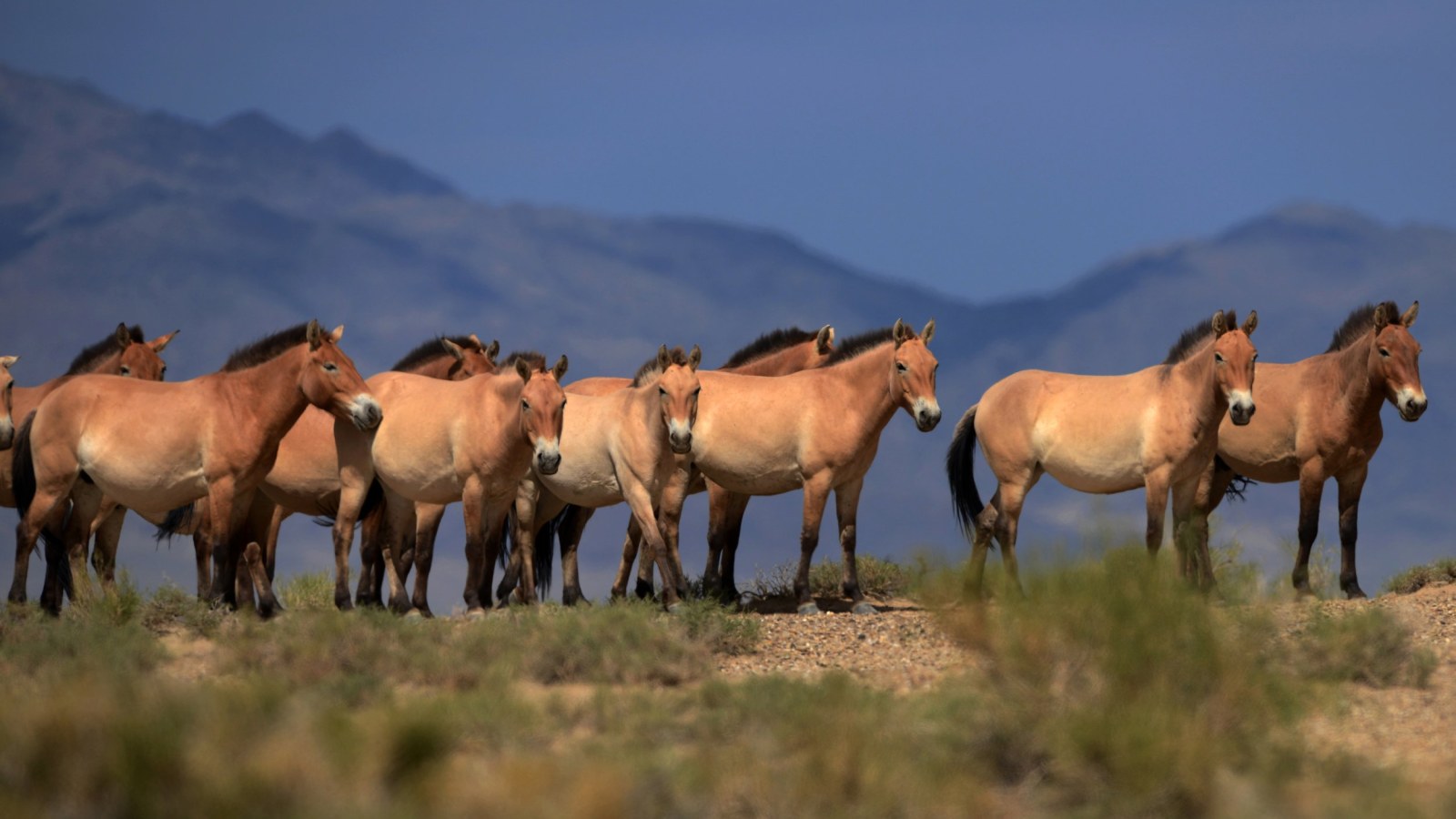
Careful examination of the horse figures reveals characteristics remarkably similar to those of Przewalski’s horse, the last surviving wild horse species.
These animals possess:
- Stocky builds
- Short upright manes
- Large heads
- Dun-colored coats
- Dark markings along the back
Many of these features appear surprisingly consistent with the ancient cave paintings.
A Rare Survivor
Przewalski’s horses nearly vanished during the twentieth century. By the 1960s, they had disappeared from the wild entirely.
For a time, it seemed that humanity was witnessing the final chapter of a lineage stretching deep into prehistory.
But that was not the end of the story.
The Unexpected Return
Conservation programs launched across multiple countries worked to breed and reintroduce these horses into suitable habitats.
Then came one of the most surprising developments.
Some populations were introduced into the Chernobyl exclusion zone, an area abandoned after the 1986 nuclear disaster.
At first glance, the location seemed completely unsuitable. Yet over time, the horses adapted and established thriving herds.
Today, wild Przewalski’s horses roam landscapes that have become an unusual refuge for wildlife.
It is a remarkable image: animals resembling those painted during the Ice Age wandering through a region associated with one of modern history’s most infamous catastrophes.
The Questions Historians Still Can’t Fully Answer

Are These the Same Horses Seen by Ice Age Artists?
This question continues to spark discussion.
Mainstream archaeological interpretation suggests that the horses painted at Lascaux likely resembled the ancestors of modern Przewalski’s horses.
However, establishing a direct one-to-one connection across thousands of generations remains difficult.
Genetic studies have dramatically improved our understanding of horse evolution, but the complete picture is still being refined.
How Much Has the Species Changed?
Another mystery involves appearance and behavior.
While modern Przewalski’s horses share many physical traits with ancient depictions, researchers continue investigating how environmental pressures may have altered the species over millennia.
Did Ice Age populations look exactly the same? Or were there subtle differences now lost to time?
The evidence remains incomplete.
Competing Theories and Interpretations
Mainstream Scientific View
Most archaeologists believe the Lascaux artists painted horses they observed directly in their environment.
The similarities to Przewalski’s horses are viewed as evidence that these ancient wild horses survived in related forms into the modern era.
Alternative Interpretations
Some researchers propose that the cave paintings may represent multiple horse populations rather than a single type.
Others suggest that artistic conventions could exaggerate certain features, making precise identification more challenging.
These ideas remain hypotheses rather than established conclusions.
Legends Versus Evidence
Popular stories occasionally portray Przewalski’s horses as unchanged survivors from the Ice Age.
While compelling, this claim oversimplifies a complex evolutionary history.
The evidence suggests continuity, but not complete biological stasis.
Evidence Hidden Across Millennia
The strongest clues come from multiple fields working together:
- Archaeological discoveries
- Cave art analysis
- Genetic research
- Fossil evidence
- Conservation biology
Each discipline contributes pieces to a puzzle spanning thousands of years.
Yet no single source provides all the answers.
And that uncertainty is precisely what makes the mystery so fascinating.
Why This Story Still Matters Today
The connection between prehistoric art and living animals reminds us that history is not always buried beneath the ground.
Sometimes it is still walking among us.
Przewalski’s horses demonstrate how conservation efforts can rescue species once thought lost from the wild.
They also offer a rare opportunity to study an animal lineage that may preserve echoes of the ancient world.
For archaeologists, historians, and wildlife researchers alike, these horses serve as a bridge between distant ages.
Modern Discoveries and New Research
Advances in DNA analysis continue transforming our understanding of horse evolution.
Researchers can now compare ancient remains with modern populations in ways unimaginable just a few decades ago.
At the same time, ongoing monitoring of horse herds in places like the Chernobyl exclusion zone is providing valuable data about adaptation, behavior, and ecosystem recovery.
Every new discovery helps answer old questions.
But almost inevitably, it raises new ones.
Final Thoughts
The ancient artists of Lascaux could never have imagined that their paintings would survive for thousands of years.
Nor could they have known that animals resembling those they painted might one day roam a landscape forever linked to modern history.
The connection between the cave horses and today’s Przewalski’s horses remains one of archaeology’s most captivating stories.
It is a tale of survival, extinction, rediscovery, and scientific investigation.
And even after 17,000 years, one question still lingers:
How much of the ancient world is truly gone—and how much is still quietly living among us?
What Readers Are Saying
- Michael Turner: “The connection between cave paintings and living animals completely changed how I think about history.”
- Emily Carter: “I had no idea wild horses were thriving in Chernobyl. Fascinating read.”
- David Brooks: “The mystery unfolded perfectly. I couldn’t stop reading.”
- Sarah Mitchell: “This made archaeology feel alive rather than distant.”
- Ryan Foster: “The balance between science and mystery was excellent.”
- Jessica Reed: “One of the most interesting historical stories I’ve read this year.”
- Daniel Cooper: “Now I want to learn more about Ice Age art.”
- Olivia Hayes: “The idea that ancient horses still exist today is incredible.”
Frequently Asked Questions
Are Przewalski’s horses the same animals shown in the Lascaux cave paintings?
Not necessarily the exact same population, but many researchers believe the paintings depict horses closely related to the ancestors of modern Przewalski’s horses.
Why are Przewalski’s horses important?
They are considered the last surviving wild horse species and provide valuable insights into horse evolution and conservation.
Why do horses live in the Chernobyl exclusion zone?
The area has limited human activity, allowing wildlife populations to expand despite the region’s unusual history.
Has DNA research helped solve the mystery?
Yes. Genetic studies have significantly improved understanding of horse ancestry, although many questions remain under investigation.
Can visitors see the original Lascaux cave paintings?
The original caves are protected, but detailed replicas and visitor centers allow people to experience the artwork.
Why is this topic still debated?
Because archaeological, genetic, and artistic evidence continues to evolve, leaving room for new interpretations and discoveries.