Some ancient monuments impress with their size. Others leave visitors speechless because of a single question: how was this even possible? Deep within Mexico’s Yucatán Peninsula, one remarkable Maya structure continues to inspire awe, not only for its beauty but for the extraordinary knowledge hidden within every carefully placed stone.

At first glance, it appears to be a magnificent ceremonial entrance. Look closer, however, and an even more fascinating story begins to emerge.

The Ancient City That Still Captivates Archaeologists
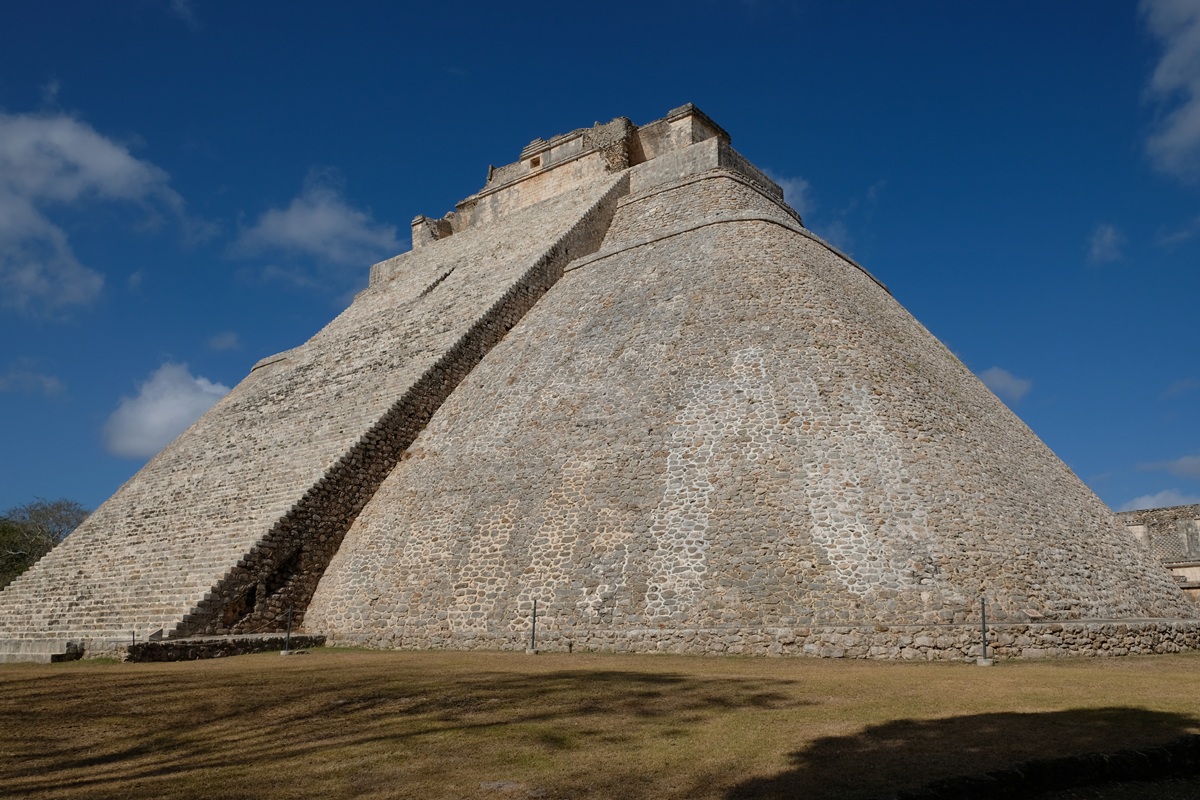
Uxmal was one of the most important cities of the ancient Maya world, flourishing between the 7th and 10th centuries CE. Located in what is now the Mexican state of Yucatán, the city became a major political, religious, and cultural center.

Unlike many Maya sites hidden beneath dense jungle for centuries, Uxmal’s elegant architecture quickly distinguished it from other ancient cities.
Its buildings showcase the famous Puuc architectural style, characterized by smooth lower walls, elaborate upper facades, geometric decorations, and intricate stone mosaics.
Yet one feature continues to draw particular attention: the monumental corbelled archways that seem to frame the sky itself.
What Archaeologists Know About the Structure
Engineering Without Metal Tools
One of the most impressive facts about Uxmal is that its builders achieved extraordinary precision without using metal tools.
The Maya shaped limestone blocks with remarkable accuracy, creating structures that have endured for more than a thousand years.
Archaeological evidence indicates that builders relied on sophisticated planning, skilled craftsmanship, and generations of accumulated knowledge.
Every stone appears carefully calculated. Every angle seems intentional.
The Meaning Behind the Decorations
The decorative stone mosaics are far more than artistic embellishments.
Many feature geometric patterns, symbolic motifs, and stylized masks often associated with important Maya deities, particularly rain and fertility gods connected to agricultural prosperity.
These carvings reveal how closely Maya architecture was tied to religion, astronomy, and political authority.
The buildings were not simply places to occupy. They communicated power, identity, and cosmic order.
What the Ruins Reveal

For archaeologists, Uxmal serves as a stone archive.
Its architecture provides clues about social organization, religious practices, engineering techniques, and artistic traditions.
Researchers have discovered that many structures were aligned according to astronomical observations. This suggests that Maya planners integrated celestial events into urban design.
But that is only part of the story.
The sheer consistency of the stonework raises questions about the training systems, labor organization, and mathematical understanding that made such precision possible.
The Questions That Continue to Fascinate Researchers
How Did They Achieve Such Precision?
Mainstream archaeology attributes the achievement to highly skilled craftsmen, sophisticated measurement techniques, and centuries of architectural development.
Evidence strongly supports this interpretation.
Yet many visitors remain amazed that such intricate designs were created without modern equipment.
What Was the Full Symbolic Meaning?
While many decorative elements have been partially interpreted, some symbols remain debated.
Researchers continue studying Maya iconography to better understand how these visual messages were understood by ancient audiences.
Could certain carvings contain meanings that modern scholars have not fully decoded?
The possibility keeps investigation ongoing.
Competing Interpretations and Theories
Several explanations attempt to account for the extraordinary sophistication seen at Uxmal.
- Mainstream Interpretation: The structures represent the culmination of centuries of Maya engineering, mathematics, astronomy, and artistic development.
- Religious Interpretation: Architectural designs were intended to symbolize cosmic order and strengthen connections between rulers, gods, and society.
- Cultural Network Theory: Knowledge spread through extensive interactions among Maya cities, accelerating innovation and architectural refinement.
Importantly, archaeologists generally agree that the evidence supports human ingenuity and organized societal development rather than extraordinary external influences.
Why This Ancient Wonder Still Matters Today
Standing before these stone facades, many people experience something difficult to describe.
The structures challenge modern assumptions about ancient societies.
They remind us that technological sophistication does not always depend on metal tools, machinery, or industrial systems.
Instead, Uxmal demonstrates how knowledge, planning, creativity, and cooperation can produce achievements that survive for centuries.
In many ways, the city serves as a bridge between the modern world and one of humanity’s most remarkable civilizations.
Modern Discoveries and New Research
Recent archaeological techniques continue revealing new details about Maya cities.
Advanced mapping technologies, digital modeling, and improved conservation methods allow researchers to examine structures with unprecedented accuracy.
These tools are helping scholars better understand construction sequences, urban planning, and the environmental conditions that shaped Maya development.
And with every new study, another piece of the puzzle emerges.
Yet many questions remain unanswered.
That lingering mystery may be one reason Uxmal continues to capture the imagination of historians, archaeologists, and travelers alike.
Final Thoughts
The magnificent stone gateway of Uxmal is more than an architectural achievement. It is a testament to the intellectual and artistic brilliance of the ancient Maya.
Its elegant arches, symbolic carvings, and astonishing precision continue to inspire admiration more than a thousand years after their creation.
While archaeology has revealed much about this extraordinary city, the deeper story of its builders continues to unfold.
And perhaps that is what makes Uxmal so compelling. Every stone seems to tell a story—yet some chapters remain waiting to be discovered.
What Readers Are Saying
- Michael Turner: “I knew Uxmal was important, but this article made me appreciate just how advanced the Maya really were.”
- Emily Carter: “The connection between architecture and astronomy is absolutely fascinating.”
- David Brooks: “I found myself wanting to visit the site immediately after reading this.”
- Sarah Mitchell: “The balance between archaeology and mystery kept me engaged the entire time.”
- James Walker: “It’s incredible that such precision was achieved without metal tools.”
- Rachel Green: “One of the most interesting explanations of Maya architecture I’ve read.”
- Thomas Reed: “The unanswered questions make the story even more captivating.”
- Olivia Bennett: “I learned more in five minutes than I had from several documentaries.”
Frequently Asked Questions
What is Uxmal famous for?
Uxmal is famous for its exceptionally preserved Puuc-style architecture, elaborate stone mosaics, and its importance as a major Maya city.
When was Uxmal built?
Most of the city’s major structures were constructed between the 7th and 10th centuries CE.
Did the Maya use metal tools to build Uxmal?
No. Archaeological evidence indicates that the Maya primarily worked with stone tools and highly refined construction techniques.
Why are the carvings at Uxmal important?
The carvings provide insight into Maya religion, political authority, symbolism, and artistic traditions.
Is Uxmal considered a mystery today?
Much about Uxmal is understood, but researchers continue investigating aspects of its symbolism, construction methods, and social organization.
Can visitors explore Uxmal today?
Yes. Uxmal is one of Mexico’s most significant archaeological destinations and attracts visitors from around the world.