Some archaeological discoveries are remarkable because of what they reveal. Others are astonishing simply because they exist at all. Hidden within the ruins of Bronze Age Crete stand enormous clay vessels so large that they seem almost impossible for an ancient society to have produced, transported, and used on a daily basis.

These colossal containers, known as pithoi, offer a rare glimpse into the economic engine of one of Europe’s earliest advanced civilizations. Yet the more researchers study them, the more fascinating questions emerge.

The Giant Storage Vessels of Ancient Crete
The Minoan civilization flourished on the island of Crete during the Bronze Age and is widely regarded as one of the most sophisticated cultures of the ancient Mediterranean.

Among the most famous archaeological sites associated with the Minoans is Knossos, often identified as the political, economic, and ceremonial center of the civilization.
During excavations of the Palace of Minos at Knossos, archaeologists uncovered dozens of massive terracotta storage jars known as pithoi. Dating to approximately 1450–1375 BCE, these vessels were designed to hold large quantities of valuable commodities.
At first glance they appear to be oversized pottery. But that description barely captures their true scale.
More Than Just Ancient Jars
Built on a Monumental Scale
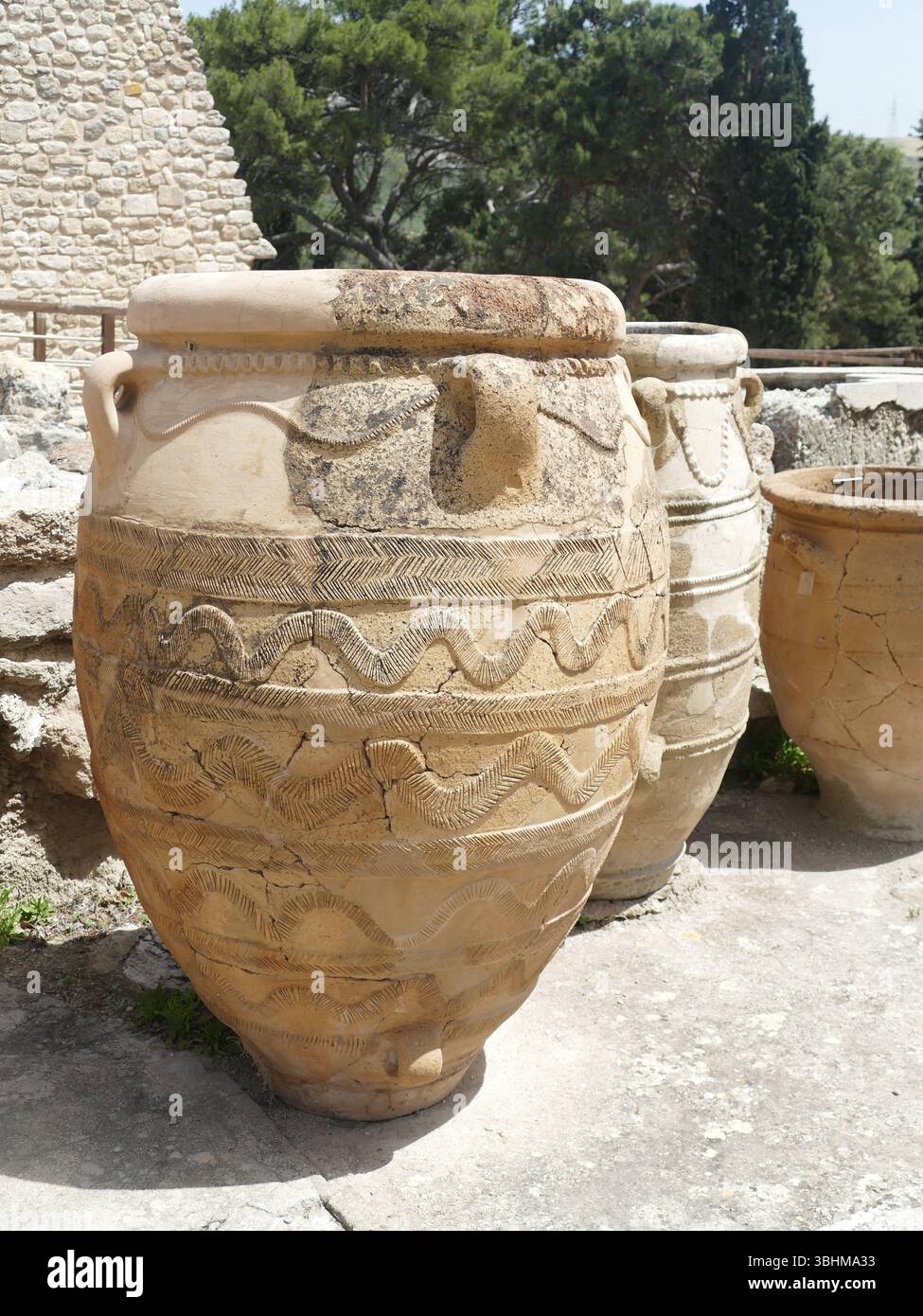
Some Minoan pithoi stand over two meters tall. Their enormous size allowed them to store significant amounts of olive oil, wine, grain, and other agricultural products essential to palace administration.
Many were placed in specialized storage rooms known as magazines, where rows of giant vessels lined the walls.
And that is where the story becomes particularly interesting.
The sheer number of pithoi discovered suggests a highly organized system of collection, storage, and redistribution. Rather than serving individual households, these containers appear to have supported a centralized economic network.
Decorative Yet Functional
Although practical in purpose, many pithoi were carefully decorated.
Archaeologists have documented relief bands, rope-like patterns, ridges, and other ornamental features molded directly into the clay. These designs may have strengthened the vessel walls, improved handling, or carried symbolic significance.
Even objects intended for storage seem to have reflected the artistic traditions of Minoan society.
What Archaeologists Know
Unlike many ancient mysteries that rely heavily on speculation, the purpose of the pithoi is supported by substantial archaeological evidence.
- They were found in palace storage areas.
- Their size made them suitable for bulk commodities.
- Residue analysis from similar vessels has revealed traces consistent with oils, wine, and agricultural products.
- Their distribution matches patterns expected in a centralized palace economy.
These findings support the mainstream interpretation that pithoi played a critical role in storing and managing resources throughout the Minoan world.
But some questions remain unanswered.
The Questions Researchers Still Debate
How Were They Manufactured?
Creating a vessel over two meters tall is no simple task, even with modern equipment.
Researchers believe the jars were built in sections using coils of clay that were gradually assembled and shaped before firing. However, the precise techniques used to prevent cracking and structural failure continue to attract scholarly interest.
How Were They Moved?
Once completed, these containers could weigh hundreds of kilograms.
Did workers transport them before firing? Were they built near their final locations? Did specialized teams oversee their movement within palace complexes?
Evidence offers clues, but definitive answers remain elusive.
Competing Theories and Interpretations
Mainstream Archaeological View
The dominant interpretation holds that pithoi were part of an advanced administrative system.
Under this model, agricultural products were collected from surrounding communities, stored within palace complexes, and redistributed according to economic and political needs.
This theory aligns with archaeological evidence from Knossos and other Minoan sites.
Alternative Hypotheses
Some researchers have explored whether certain pithoi may have held specialized goods, ceremonial offerings, or emergency reserves.
Others have suggested that decorative features may have conveyed information about ownership, contents, or administrative control.
These ideas remain hypotheses rather than established conclusions, but they highlight how much there is still to learn.
Evidence Hidden in Plain Sight
One of the most fascinating aspects of the pithoi is that they reveal the invisible infrastructure behind an ancient civilization.
Grand palaces, colorful frescoes, and ceremonial spaces often capture public attention. Yet none of those achievements could have been sustained without effective systems for storing food and resources.
The giant jars represent the practical foundation upon which Minoan society was built.
In many ways, they tell a story just as important as the palace itself.
Why This Discovery Still Matters Today
The pithoi of Knossos provide valuable evidence for understanding how complex societies developed long before modern states emerged.
They demonstrate sophisticated planning, large-scale production, and centralized resource management during a period when much of Europe remained comparatively less urbanized.
They also remind us that technological innovation does not always appear in the form of machines or monuments. Sometimes it appears as a brilliantly designed solution to everyday challenges.
Modern Discoveries and New Research
Advances in archaeological science continue to shed new light on these remarkable vessels.
Researchers now employ residue analysis, microscopic examination, digital reconstruction, and material studies to investigate how pithoi were produced and used.
Each new study helps refine our understanding of Bronze Age economies, trade networks, and food storage practices.
Yet despite decades of research, the giant jars still hold secrets.
And that lingering uncertainty is part of what makes them so captivating.
What Readers Are Saying
- Michael Turner: “I had no idea ancient storage systems could be this fascinating. The scale of these vessels is incredible.”
- Emily Carter: “The article kept me curious all the way through. Every section revealed something new.”
- David Brooks: “It’s amazing how much we can learn about a civilization from something as simple as a storage jar.”
- Sophia Reed: “The balance between archaeology and mystery was perfect.”
- James Walker: “Now I want to learn more about the Minoans and Bronze Age Crete.”
- Olivia Grant: “The questions about how these massive vessels were moved really got me thinking.”
- Nathan Cooper: “A fascinating look at the hidden side of ancient civilizations.”
- Rachel Foster: “This made archaeology feel like a real detective story.”
Frequently Asked Questions
What is a Minoan pithos?
A pithos is a large terracotta storage vessel used by the Minoans to store bulk commodities such as olive oil, wine, grain, and other resources.
How old are the pithoi found at Knossos?
Many of the famous examples date to approximately 1450–1375 BCE during the Late Bronze Age.
Why were the jars so large?
Their size allowed palace administrators to store substantial quantities of agricultural products essential for managing the economy.
Do archaeologists know exactly what was stored inside them?
Evidence strongly suggests products such as oil, wine, and grain, although the contents likely varied depending on location and purpose.
Can visitors see these pithoi today?
Yes. Examples can be viewed at archaeological sites and museums associated with Minoan Crete, including displays connected to Knossos.
Why are the pithoi important to archaeology?
They provide direct evidence of large-scale storage, resource management, and economic organization within one of the ancient world’s most influential civilizations.
Final Thoughts
The giant pithoi of Knossos may not be as famous as pyramids or temples, but they reveal something equally important: how a sophisticated civilization sustained itself day after day.
These towering vessels stored the resources that fueled palaces, supported communities, and helped shape the history of Bronze Age Crete.
Thousands of years later, they continue to raise intriguing questions. How exactly were they built? How were they transported? And what additional secrets remain hidden within the archaeological record?
For now, the answers remain partly buried in the past—waiting for the next discovery to bring them to light.