Some ancient monuments impress visitors with their size. Others do something far more remarkable—they leave people wondering how art, religion, and symbolism became so perfectly intertwined. High on the Acropolis of Athens stands one such mystery, where six stone maidens have watched over history for more than two millennia.

At first glance, they appear to be elegant sculptures. Look closer, however, and an intriguing question emerges: why were these women chosen to support an entire temple structure, and what deeper meaning were the ancient Greeks trying to preserve?

The Temple Unlike Any Other
The Porch of the Caryatids forms part of the Erechtheion, one of the most distinctive buildings on the Acropolis in Athens, Greece.

Constructed during the Classical period of Ancient Greece in the late fifth century BCE, the Erechtheion was dedicated to both Athena and Poseidon. It was built on a site considered sacred because several important myths and religious traditions were connected to the location.
Unlike the symmetrical temples commonly associated with Greek architecture, the Erechtheion has an unusual design. Its irregular shape reflects the complex sacred landscape it was built to accommodate.
Yet among all its remarkable features, one section attracts the most attention.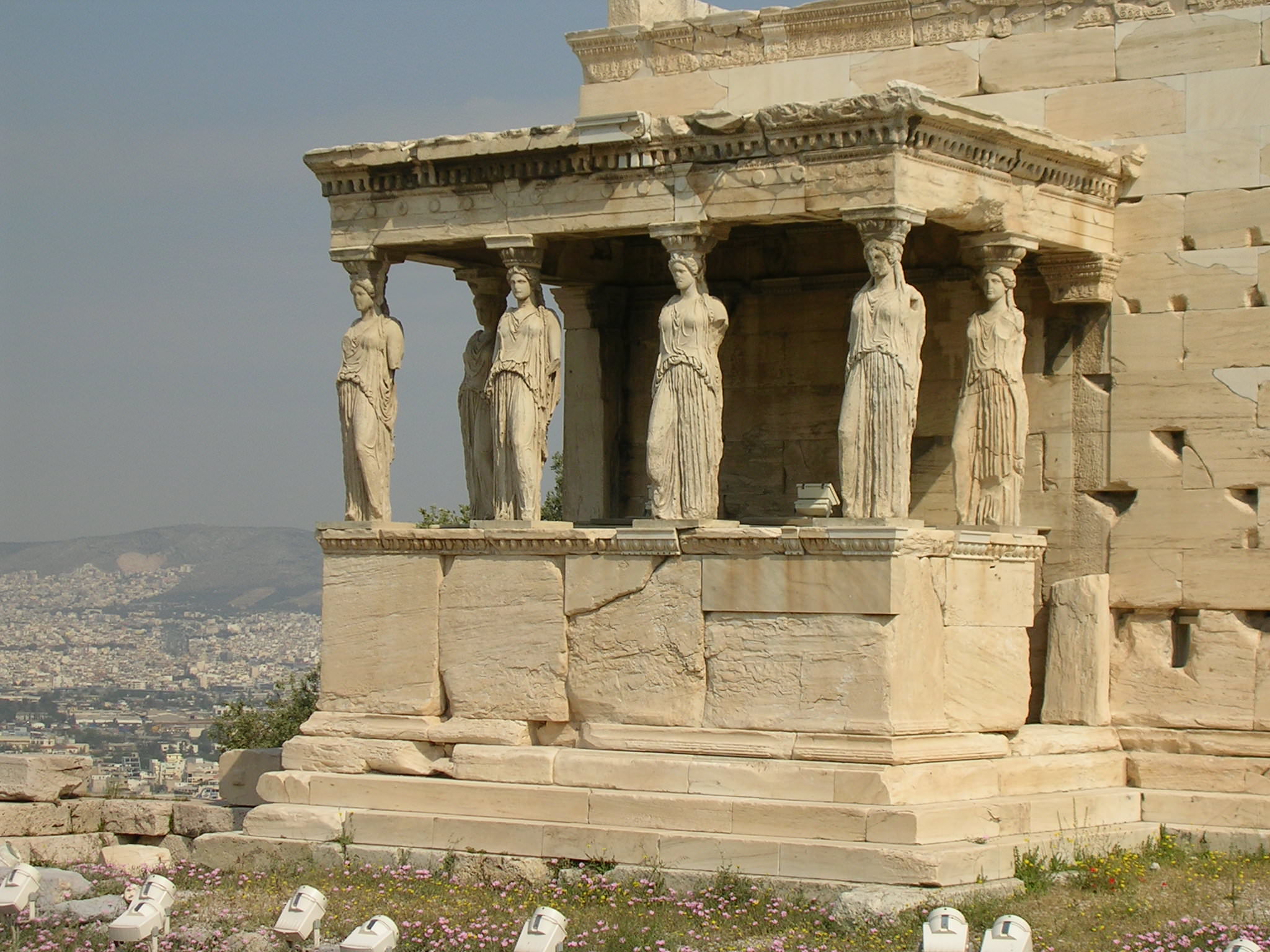
The Stone Maidens Who Carry a Temple
More Than Decorative Sculptures
The southern porch of the Erechtheion is supported by six female figures known as Caryatids.
Rather than using traditional columns, the architects created life-sized sculpted women that perform a structural role while maintaining extraordinary artistic elegance.
Each figure appears similar at first glance. But that impression quickly fades.
Every Caryatid possesses unique details in posture, drapery, hairstyle, and facial features. Ancient craftsmen carefully balanced artistic individuality with overall harmony.
What happened next surprised many later observers.
These sculptures became some of the most famous architectural figures ever created, influencing buildings across Europe and beyond for centuries.
What Archaeologists Know
Evidence Preserved in Stone
Archaeologists generally agree on several important facts.
- The Caryatids served both structural and decorative purposes.
- The figures were carved from high-quality marble.
- The porch formed an important ceremonial element of the Erechtheion.
- The sculptures originally displayed painted details, although most color has disappeared over time.
- The surviving originals are now preserved in controlled museum environments, while replicas stand on the monument.
The engineering achievement remains impressive. The sculptors successfully created human forms capable of supporting architectural weight without sacrificing aesthetic beauty.
But understanding their symbolism is far more complicated.
The Questions Historians Still Debate
Who Were the Caryatids Intended to Represent?
One of the most discussed mysteries concerns the identity of the figures themselves.
Mainstream scholarship suggests they may represent priestesses, attendants of Athena, or idealized noble women participating in sacred rituals.
However, ancient sources do not provide a universally accepted explanation.
That uncertainty has fueled centuries of debate.
The Connection to Ancient Legends
Some historical interpretations connect the figures to women from a place called Caryae, a town associated with religious festivals honoring Artemis.
According to later traditions, the name “Caryatid” may have originated from these ceremonial associations.
Yet historians continue to examine whether this explanation fully accounts for the figures’ role within the Erechtheion.
And that leaves room for further questions.
Competing Theories and Their Evidence
The Sacred Attendants Theory
This remains one of the most widely accepted interpretations.
Supporters argue that the figures symbolize women participating in religious ceremonies connected to Athena and the sacred traditions of the Acropolis.
Supporting evidence:
- The temple’s religious purpose.
- The dignified appearance of the figures.
- Their placement within a sacred architectural setting.
The Heroic Ancestors Theory
Some researchers have proposed that the figures may represent legendary women connected to Athens’ distant past.
Supporting evidence:
- The importance of ancestral myths in Greek culture.
- The Erechtheion’s connection to multiple legendary traditions.
However, direct archaeological proof remains limited.
The Symbolic Architecture Theory
Another interpretation suggests that the figures were intended primarily as artistic symbols of stability, beauty, and civic identity rather than representations of specific individuals.
Supporting evidence:
- Their idealized appearance.
- The integration of sculpture and architecture.
- The broader artistic trends of Classical Greece.
No single theory has completely resolved the debate.
Why This Mystery Still Matters Today
The fascination surrounding the Caryatids goes beyond archaeology.
They represent a rare moment when engineering, religion, mythology, and artistic expression merged into a single creation.
Modern architects continue to study their design.
Art historians analyze their symbolism.
Visitors from around the world stand before them asking the same question people have asked for generations:
What message were the ancient builders hoping would survive through the ages?
That question remains remarkably relevant.
Modern Discoveries and New Research
Technology Reveals New Clues
Recent conservation efforts and advanced imaging techniques have provided fresh insights into the sculptures.
Researchers can now study carving methods, surface details, and weathering patterns with far greater precision than earlier generations.
These investigations continue to improve our understanding of how the figures were created and maintained.
Yet despite modern technology, some mysteries remain stubbornly unresolved.
Sometimes the most fascinating discoveries do not provide final answers—they reveal how much more there is to learn.
Final Thoughts
The Porch of the Caryatids stands as one of the most recognizable masterpieces of Ancient Greece.
Its stone figures have endured wars, empires, environmental damage, and the passage of more than two thousand years.
Archaeologists have uncovered much about their construction and purpose, but their full meaning continues to inspire debate.
Perhaps that is precisely why they remain so captivating. The Caryatids are not merely relics of the past. They are silent witnesses to history, still inviting each new generation to search for answers hidden within the marble.
And after all this time, one mystery remains: are we looking at architectural supports, sacred guardians, or something far more symbolic?
What Readers Are Saying
- Michael Turner: “I knew the Acropolis was famous, but I never realized how much mystery surrounds these sculptures.”
- Emily Carter: “The combination of archaeology and unanswered questions made this fascinating to read.”
- David Brooks: “Now I want to learn more about the Erechtheion and Ancient Greek religion.”
- Sophia Reed: “The way the story gradually unfolded kept me engaged until the end.”
- James Collins: “It’s amazing that such ancient artwork still sparks debate today.”
- Olivia Hayes: “I loved how the article separated facts from theories.”
- Benjamin Ward: “One of the most interesting pieces I’ve read about Greek archaeology.”
- Natalie Foster: “The Caryatids feel even more mysterious after learning their history.”
Frequently Asked Questions
What are the Caryatids?
The Caryatids are sculpted female figures that function as architectural supports on the Porch of the Caryatids at the Erechtheion.
Why were women used instead of columns?
Scholars believe the figures combined structural engineering with symbolic and religious significance, though the exact meaning remains debated.
Are the original Caryatids still on the temple?
No. The original sculptures are preserved in museums for protection, while carefully crafted replicas stand on the monument.
What is the Erechtheion?
The Erechtheion is a sacred temple on the Acropolis of Athens dedicated primarily to Athena and Poseidon.
Why is the Porch of the Caryatids famous?
It is considered one of the greatest examples of Classical Greek architecture and sculpture working together in a single design.
Can visitors see the site today?
Yes. The Acropolis remains one of Greece’s most visited archaeological sites and attracts millions of visitors interested in ancient history and architecture.