Some ancient ruins are easy to admire from a safe distance. Others seem to challenge anyone who dares to approach them.

High in the rugged landscape of ancient Cilicia, near the forgotten settlement of Kanytelis in modern Turkey, a remarkable Roman aqueduct still clings to the mountainside. Weathered by centuries of wind, rain, and earthquakes, it remains a silent reminder of an engineering achievement that once brought life-giving water across difficult terrain.

Yet the closer visitors get, the more questions emerge. How was such a structure built in such a dangerous location? And why does it continue to survive after nearly two thousand years?

The Mountain Aqueduct of Ancient Cilicia
Ancient Cilicia occupied a strategic position along the eastern Mediterranean coast. The region was known for its rugged mountains, fertile valleys, and important trade routes connecting different parts of the Roman world.
To support growing settlements, Roman engineers constructed extensive infrastructure. Among their most impressive achievements were aqueducts—carefully designed systems that transported water over long distances using gravity alone.
The aqueduct near Kanytelis stands as one of these remarkable survivals. Positioned within challenging terrain, it demonstrates the extraordinary determination of Roman builders to bring reliable water supplies to communities regardless of geographical obstacles.
At first glance, it may seem like just another ancient ruin. But that impression quickly changes when one considers where it was built.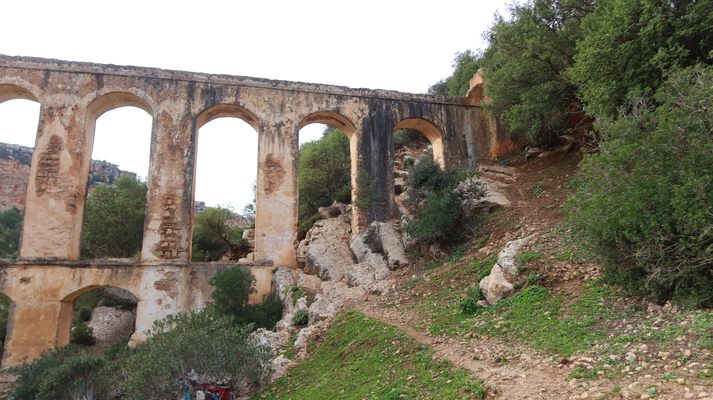
What Archaeologists Know
Engineering Designed for Survival
Archaeologists recognize Roman aqueducts as among the most sophisticated infrastructure projects of the ancient world.
Rather than relying on pumps, engineers calculated incredibly precise gradients that allowed water to flow naturally over many kilometers. Even small errors could cause an entire system to fail.
The surviving sections near Kanytelis reveal typical Roman construction techniques:
- Carefully cut stone masonry
- Durable arches and support structures
- Channels engineered to maintain consistent water flow
- Adaptation to steep mountainous landscapes
These features reflect a combination of practical engineering and long-term planning that continues to impress researchers today.
A Region Rich in Ancient Remains
Kanytelis and the surrounding landscape contain numerous archaeological remains, including tombs, religious structures, and infrastructure networks.
The aqueduct was not an isolated project. It formed part of a larger system that supported settlements, agriculture, and daily life throughout the region.
But that’s only part of the story.
How Did Roman Builders Construct It?
This question continues to fascinate visitors.
Modern observers often underestimate the logistical challenges faced by ancient builders. Transporting stone, tools, and laborers through mountainous terrain would have required enormous organization.
Unlike modern construction crews equipped with heavy machinery, Roman workers relied on human labor, animals, simple lifting devices, and remarkable planning.
Some sections appear positioned in locations that remain difficult to access even today.
And that raises an intriguing possibility: were Roman engineers even more capable than we sometimes assume?
Competing Interpretations
Mainstream Archaeological View
The accepted interpretation among archaeologists is straightforward.
The aqueduct represents a highly skilled example of Roman civil engineering. Through careful surveying, disciplined labor, and accumulated experience, Roman builders successfully transported water across challenging terrain.
Numerous surviving aqueducts throughout the former Roman Empire support this explanation.
Alternative Speculations
Some visitors and enthusiasts suggest that certain ancient structures appear almost impossible to build using ancient technology alone.
These interpretations often point to the precision of construction or the difficulty of the location.
However, no credible archaeological evidence currently suggests that unknown technologies were involved in the construction of this aqueduct.
The available evidence continues to support conventional Roman engineering methods.
Still, the sheer ambition of the project remains impressive enough without requiring extraordinary explanations.
Evidence Hidden in Stone
Ancient structures often reveal their secrets gradually.
Every surviving arch, stone block, and channel provides clues about construction techniques and maintenance practices.
Researchers examine:
- Tool marks left by workers
- Stone-cutting methods
- Structural repairs made over time
- Patterns of weathering and collapse
Each detail contributes to a better understanding of how the aqueduct functioned and how long it remained in use.
Yet some questions may never receive complete answers.
Why The Mystery Still Matters Today
The fascination surrounding ancient aqueducts is not merely about engineering.
These structures reveal how civilizations solved problems that affected everyday life: water supply, urban growth, public health, and long-term sustainability.
They also remind us that many ancient societies possessed levels of technical expertise that are often overlooked.
Standing near such a monument creates a powerful connection between the modern world and people who lived nearly two millennia ago.
And when the surrounding landscape remains steep and dangerous, that connection feels even stronger.
Modern Discoveries and Ongoing Research
New technologies continue to transform archaeological research.
High-resolution mapping, drone photography, satellite imagery, and 3D modeling allow researchers to document structures that are difficult or dangerous to reach.
In regions like Cilicia, these methods are helping archaeologists better understand ancient transportation networks, settlement patterns, and water-management systems.
What happened next surprised many researchers: landscapes once thought to be fully understood often reveal new details when viewed through modern technology.
As investigations continue, even familiar ruins may provide unexpected discoveries.
What Readers Are Saying
- Michael Turner: “I never realized how much planning went into Roman aqueducts. Fascinating read.”
- Emily Carter: “The combination of archaeology and engineering made this incredibly engaging.”
- David Brooks: “Now I want to explore ancient Cilicia myself.”
- Sarah Mitchell: “The mountain setting makes the story even more impressive.”
- James Walker: “It’s amazing that structures like this still survive today.”
- Olivia Harris: “I appreciated the balance between evidence and speculation.”
- Ryan Foster: “The mystery kept me reading until the end.”
- Sophia Reed: “Ancient engineering continues to amaze me.”
Frequently Asked Questions
What was the purpose of the aqueduct near Kanytelis?
Its primary purpose was to transport water to settlements and support daily life, agriculture, and public facilities.
How old is the aqueduct?
While precise dating varies by section, it is generally associated with the Roman period and may be nearly two thousand years old.
Did the Romans really build structures in such difficult locations?
Yes. Throughout the Roman Empire, engineers constructed roads, bridges, tunnels, and aqueducts across mountains, valleys, and challenging terrain.
Is there evidence of advanced lost technology?
No credible archaeological evidence currently supports the existence of unknown advanced technology in the construction of this aqueduct.
Why does the structure still survive?
Roman builders used durable materials and effective engineering principles, allowing many structures to withstand centuries of environmental exposure.
Can visitors see the aqueduct today?
Many ancient remains in the region can still be observed, although access conditions vary and some areas may involve difficult or hazardous terrain.
Final Thoughts
Perched above the rugged landscape of ancient Cilicia, the aqueduct near Kanytelis is more than a relic of the Roman world.
It is a testament to human ingenuity, persistence, and ambition.
Centuries after the last workers laid its stones, the structure continues to inspire curiosity. Its arches still overlook the mountains. Its story still invites investigation.
And while archaeologists have uncovered much about its origins, one feeling remains unchanged for anyone who encounters it: a sense of wonder at what ancient civilizations were capable of achieving against seemingly impossible odds.