Deep in the rugged river valley of western Idaho, where the Salmon River carves through ancient basalt and pine forests whisper secrets of the past, archaeologists have unearthed a settlement that is forcing the entire scientific community to rewrite the story of the Americas.
Dated to approximately 16,000 years ago, the Cooper’s Ferry site has delivered undeniable proof of human presence in North America more than a thousand years before the long-accepted Clovis culture.
The discovery did not happen overnight.
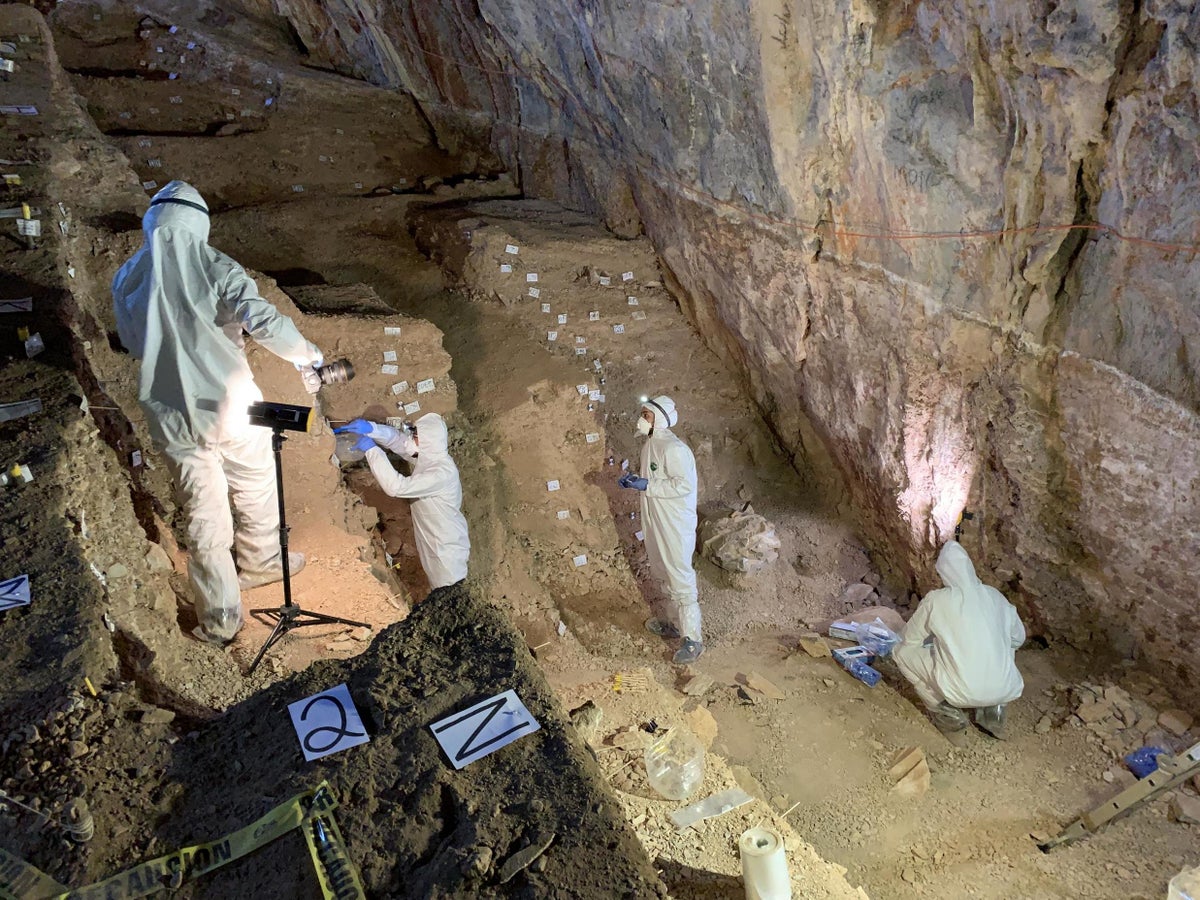
Since 2009, a dedicated team led by archaeologist Loren Davis of Oregon State University has meticulously excavated the riverbank terrace at Cooper’s Ferry.
What they found stunned even the most seasoned researchers: nearly 200 stone tools, including distinctive stemmed projectile points, flakes from tool-making, charcoal from ancient fires, and bones from extinct Pleistocene animals.
Radiocarbon dating on charcoal and animal remains placed human activity firmly between 16,560 and 15,280 years ago — a timeframe when massive ice sheets still blocked inland routes from Alaska into the heart of North America.
Picture the scene 16,000 years ago.
The last Ice Age gripped the planet.

Vast glaciers covered much of Canada, yet here, along a gentle river bend, a small group of people built fires, crafted sophisticated stone weapons, hunted large mammals, and established what appears to be a seasonal camp.
The stemmed points they left behind show advanced manufacturing techniques more reminiscent of tools from ancient Japan and East Asia than anything previously found in the Americas.
This technological fingerprint suggests the first Americans did not walk across a land bridge and trickle south through an ice-free corridor as generations of scholars once taught.
Instead, they likely traveled by boat along the Pacific coast, hugging the edge of glaciers in a perilous maritime migration from Asia.
The implications strike at the foundation of American archaeology.
For decades, the Clovis First theory reigned supreme.
Named after distinctive spear points found near Clovis, New Mexico, this model claimed the first humans entered North America around 13,000 years ago via the Bering Land Bridge, then rapidly spread south once an ice-free corridor opened.
Textbooks, museum displays, and school curricula enshrined this narrative.
Cooper’s Ferry, along with other pre-Clovis sites, has now blown that model apart.
Humans were already thriving deep in the interior of the continent while ice still sealed traditional overland routes.
The excitement in the scientific community is electric.
At Cooper’s Ferry, artifacts were found in clear stratigraphic layers, with some of the oldest tools positioned beneath younger Clovis-style points — concrete proof of pre-Clovis occupation.
The site also yielded bones from now-extinct horses and other megafauna, showing these early inhabitants hunted or scavenged large Ice Age animals.
Fire pits, tool caches, and debitage (waste flakes from stone knapping) paint a picture of repeated seasonal returns to this strategic riverside location, suggesting a level of planning and adaptation far more sophisticated than nomadic wanderers.
This discovery joins a growing chorus of evidence pushing back the timeline.
White Sands footprints in New Mexico date to 21,000–23,000 years ago.
Monte Verde in Chile once anchored pre-Clovis claims at 14,500 years, though recent debates continue.
Rimrock Draw in Oregon and other sites add to the mounting data.
Together, they force a complete rethinking of human migration.
The coastal route theory — once fringe — now stands as the leading explanation.
Ancient seafarers, possibly from Northeast Asia, navigated kelp forests and icy waters in small watercraft, carrying advanced toolkits and deep ecological knowledge that allowed them to thrive in unfamiliar lands.
The emotional weight for Indigenous communities is profound.
Many Native American oral traditions speak of ancient origins on this continent, stories long dismissed by Western science as myth.
Discoveries like Cooper’s Ferry validate those ancestral memories, bridging science and indigenous knowledge in powerful new ways.
Tribal representatives involved in the excavations express both pride and urgency — pride in the resilience of their forebears, urgency to protect such sites from development and climate threats as glaciers melt and rivers shift.
For mainstream archaeology, the shift has been humbling.
Loren Davis and his team faced skepticism when early dates emerged, but rigorous methodology, multiple dating techniques, and peer-reviewed publication in top journals like Science have built an ironclad case.
The once-dominant Clovis model, taught as unassailable fact, now looks like a regional phenomenon rather than the continent’s origin story.
This paradigm change ripples outward: if people reached Idaho 16,000 years ago, how much earlier did they first set foot on the continent?
What other undiscovered settlements lie hidden under modern cities, farmlands, or coastal waters now submerged by rising seas?
The technological sophistication at Cooper’s Ferry adds another layer of drama.
The stemmed points required precise pressure flaking — a skill demanding years of training and practice.
These weapons were lightweight, lethal, and reusable, ideal for mobile hunters following game along river corridors.
Their similarity to Upper Paleolithic tools from Japan suggests cultural connections across the Pacific, possibly via now-submerged land bridges or deliberate sea voyages.
Ancient DNA and linguistic studies may soon reveal whether these people represent a distinct early wave or ancestors of later Indigenous groups.
Climate context makes the discovery even more remarkable.
Sixteen thousand years ago, Earth was emerging from the Last Glacial Maximum.
Sea levels were lower, coastlines different, and megafauna roamed in abundance.

These pioneers adapted to rapidly changing environments, developing technologies and survival strategies that allowed them to colonize two vast continents within a few millennia.
Their success story challenges notions of primitive early humans and highlights remarkable ingenuity.
As news of the Idaho find spreads in 2026, it captivates the public imagination.
Documentaries, podcasts, and museum exhibits are rushing to update narratives.
Schoolchildren who once learned the simplified Clovis story now encounter a far richer, more mysterious tale of seafaring ancestors braving icy oceans to reach a new world teeming with mammoths and saber-toothed cats.
The revelation also raises urgent conservation questions.
Many potential early sites along the ancient Pacific coast now lie underwater due to post-Ice Age sea level rise, making underwater archaeology crucial for future discoveries.
Critics and holdouts remain, demanding even more rigorous proof and multiple independent confirmations.
Science advances through debate, and healthy skepticism drives better research.
Yet the cumulative weight of Cooper’s Ferry, White Sands, and other pre-Clovis sites has tipped the scales.
The First Americans arrived earlier, traveled differently, and possessed greater capabilities than previously imagined.
This changes not only archaeology but our collective understanding of human resilience, exploration, and the deep roots of the Americas’ first peoples.
In the quiet valley of the Salmon River, where ancient hands once shaped stone by flickering firelight, a new chapter of human history has been written in the earth itself.
The 16,000-year-old settlement at Cooper’s Ferry does more than push back dates.
It expands our sense of wonder about the past and reminds us that the story of America — indeed, the story of humanity — is still being uncovered, one careful trowel scrape at a time.
What other surprises lie waiting beneath the soil, the waves, and the ice?
The continent’s ancient inhabitants left clues.
Modern archaeologists, armed with new tools and open minds, are finally learning how to read them.
The ground has spoken.
History will never look the same again.