Most of what we know about dinosaurs comes from stone — flattened bones, faint impressions, shapes pressed into rock. We’ve spent two centuries reconstructing giants from their shadows.
This is different. This is, reportedly, the real thing.
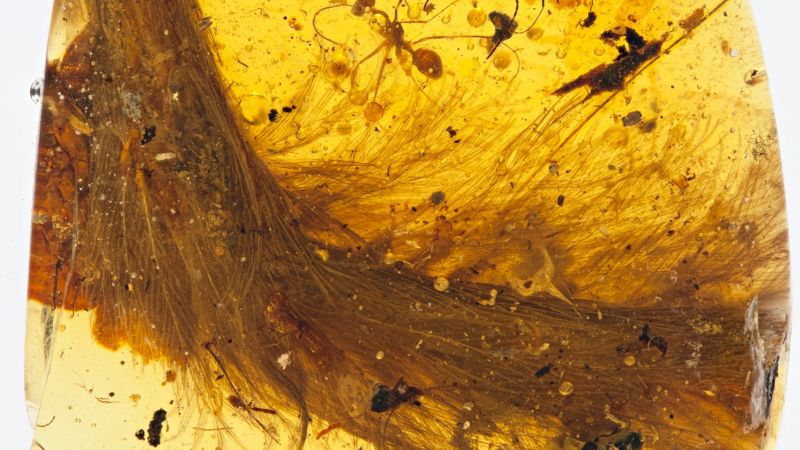
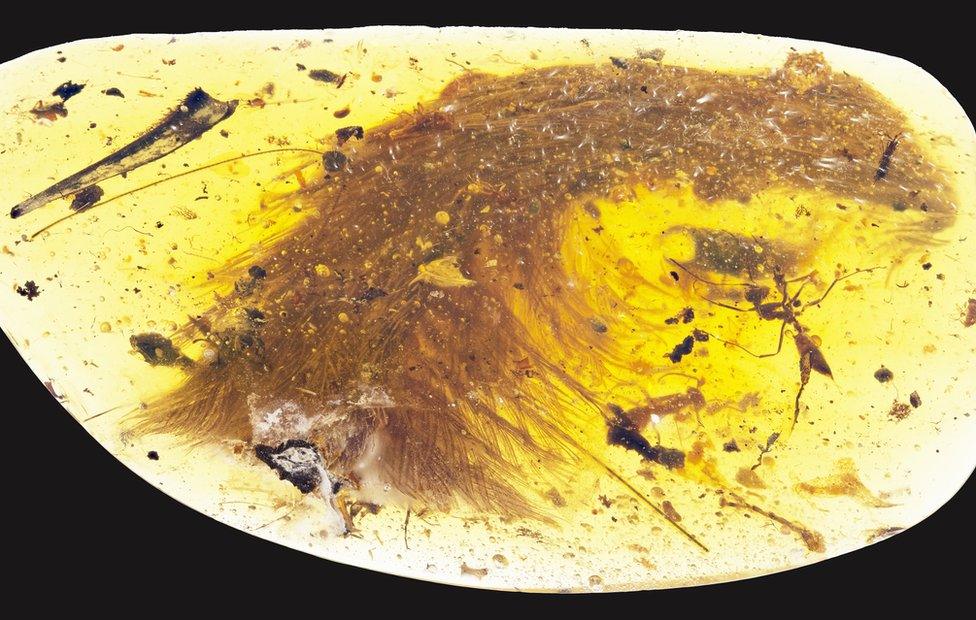
Sealed inside a piece of 99-million-year-old amber from Myanmar is a complete section of a dinosaur’s tail — bones, soft tissue, and delicate feathers — preserved in three dimensions, down to detail you can study under a microscope. Not an outline. Not a cast. An actual piece of a dinosaur, caught in golden resin and never let go.
What’s really inside the amber
According to the researchers who described it, the specimen is the tail of a juvenile coelurosaur — a group of theropods that famously includes both Velociraptor and the mighty Tyrannosaurus rex, and, eventually, modern birds.
The tail is made up of around eight vertebrae, wrapped in fine feathers that run in keels down each side. And here’s a telling detail: those vertebrae aren’t fused into the short, stiff rod (a “pygostyle”) that anchors a bird’s tail feathers. This tail is long and flexible — the tail of a dinosaur, not a bird. A small but crucial clue that places it firmly on the dinosaur side of the family tree.
The feathers, experts believe, weren’t built for flight at all. They more likely served as insulation to manage body heat — or as colour and display, the ancient equivalent of showing off.

It was almost sold as a houseplant
Here’s the part that sounds made up.
The amber reportedly first surfaced at a market, sold as a curiosity containing what looked like bits of plant — fronds frozen in resin, a pretty trinket and nothing more. It could easily have ended up as a polished ornament on someone’s shelf.
It took the sharp eye of palaeontologist Lida Xing to realise those “leaves” weren’t leaves at all. They were feathers. And the thing they were attached to was a 99-million-year-old dinosaur.
One of the most remarkable fossils of its kind was, by some accounts, a near miss — almost lost to a souvenir stall.
Why this rewrites the picture in your head
Close your eyes and imagine a dinosaur. Odds are you pictured something scaly, leathery, reptilian — the monster of old movies.
Finds like this keep telling us we had it wrong. The feathers here are soft, branching, complex — proof that elaborate feathery coats existed in dinosaurs long before any bird took to the sky.
This isn’t a picture of a dinosaur. It’s a piece of one — feathers and all — caught mid-history and never released.
Slowly, specimen by specimen, the scaly reptiles of our imagination are being replaced by something stranger and far more vivid: warm, fuzzy, possibly brightly coloured creatures that would have looked, in some ways, unsettlingly like enormous birds.

So… could we build a Jurassic Park?
It’s the question everyone secretly wants to ask. Soft tissue, in amber — isn’t that exactly how the movie started?
Sadly, no — at least, not the way Hollywood promised. Most scientists agree that DNA simply can’t survive anywhere near 99 million years; it breaks down far too fast. What amber preserves is structure, not a usable genetic blueprint.
But in a way, what it does give us is almost as wild: the chance to see a dinosaur’s feathers exactly as they were, arranged barb by barb, instead of guessing from a smudge in a rock. No movie required.
Nature’s perfect time capsule
Amber is resin that oozed from ancient trees, trapped whatever it touched, then hardened and waited. Unlike rock, which crushes and flattens, amber can hold a creature in 3D — colour patterns, individual barbs, the fine architecture of a feather — frozen at the instant it was caught.
That’s why a single lump of fossilised tree sap can sometimes tell us more than a whole slab of stone. It doesn’t preserve a memory of the animal. It preserves a piece of the animal itself.
So here’s the thought to sit with: if one small, almost-discarded chunk of amber can rewrite how we picture an entire age of life — how much more is still out there, mistaken for plants, sitting unnoticed on a shelf?