For thousands of years, she lay undisturbed beneath the soil, hidden beneath land that would eventually become a modern housing development. When archaeologists uncovered her remains, they realized they were looking at far more than an ancient skeleton—they had stumbled upon a mystery that still refuses to reveal all of its secrets.

Why was this Bronze Age woman buried with her knees tightly drawn against her chest? The answer may offer a rare glimpse into how prehistoric people viewed death, identity, and the journey beyond life.

A Discovery Beneath a Future Neighborhood
Before construction began on 41 new homes in Kent, England, archaeologists carried out a routine excavation. Such surveys often uncover traces of earlier settlements, but few produce discoveries as remarkable as this one.

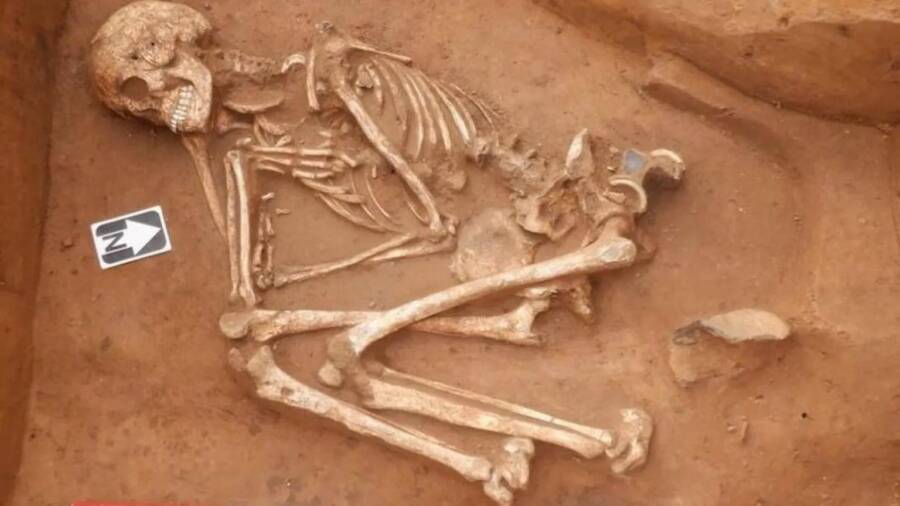
Buried deep within the ground was the exceptionally well-preserved skeleton of a woman who lived approximately 3,000 years ago during Britain’s Bronze Age. Researchers estimate that she was between 30 and 35 years old when she died.
Her burial immediately attracted attention—not because of valuable grave goods, but because of the unusual position in which she had been carefully placed.
The Burial Position That Continues to Raise Questions
Curled as Though Sleeping
The woman had been laid on her side with her knees tightly drawn toward her chest, creating what archaeologists describe as a crouch burial.
To modern observers, the position appears strikingly unusual. Yet this posture has been documented at numerous Bronze Age sites throughout Britain and parts of Europe.
The mystery is not whether such burials existed—they certainly did—but rather why they were performed.
And that is where the debate begins.
What Archaeologists Know
Current archaeological evidence suggests that crouched burials became common across Britain during much of the Bronze Age.
Excavations have revealed individuals buried on either their left or right sides, sometimes with carefully arranged limbs and occasionally accompanied by pottery, tools, jewelry, or personal ornaments.
In the Kent burial, researchers have focused primarily on the body’s careful placement rather than signs of haste or disorder.
This deliberate positioning indicates that those who buried her followed a meaningful funerary tradition rather than acting randomly.
Competing Theories Behind the Crouch Burial
The Symbolism of Rebirth
One widely discussed interpretation is that the curled posture symbolized the fetal position.
If true, those who buried the woman may have viewed death not as an ending, but as a transition into another stage of existence. Returning the body to a womb-like posture could have represented spiritual rebirth.
Although this interpretation is popular, direct evidence confirming this belief has not been found.
A Reflection of Social or Cultural Identity
Another possibility is that burial positions reflected social customs, family traditions, regional identities, or even gender-specific practices.
Different communities across Bronze Age Britain often displayed variations in burial customs despite sharing many cultural similarities.
The woman’s posture may therefore have identified her place within a particular community rather than expressing a universal religious belief.
Practical Considerations
Some researchers suggest that deep burial pits may have naturally encouraged compact body placement.
However, because many crouched burials appear intentionally arranged with considerable care, most archaeologists believe practical concerns alone cannot explain the pattern.
That leaves room for ritual significance.
Another Unexpected Discovery at the Site
The excavation revealed more than a single burial.
Archaeologists also uncovered fragments of another young woman’s skull dating to around 500 BCE, centuries after the Bronze Age burial.
This suggests the landscape continued to hold importance across different generations and cultural periods.
Whether these discoveries are directly connected remains unknown, but together they hint that this location retained significance long after the first burial took place.
Evidence—and Its Limits
Scientific archaeology provides valuable clues through radiocarbon dating, skeletal analysis, excavation records, and comparisons with similar burial sites.
These methods allow researchers to reconstruct many aspects of prehistoric life.
Yet they cannot fully recover beliefs, ceremonies, or spoken traditions that disappeared thousands of years ago.
Without written records from Bronze Age Britain, archaeologists must carefully distinguish between evidence-based conclusions and informed interpretations.
- Established evidence: The woman lived roughly 3,000 years ago and was intentionally buried in a crouched position.
- Mainstream interpretation: The burial likely followed recognized Bronze Age funerary customs.
- Alternative hypotheses: The posture may symbolize rebirth, community identity, religious beliefs, or other ritual practices.
- Unresolved mystery: No surviving written evidence explains exactly what the burial meant to the people who performed it.
Why This Mystery Still Matters Today
Ancient burials are more than archaeological discoveries—they are rare conversations across thousands of years.
Every carefully positioned hand, every artifact, and every burial choice reflects decisions made by people whose voices have long since vanished.
The Kent woman reminds us that prehistoric societies possessed rich traditions and beliefs that modern science can only partially reconstruct.
Sometimes the smallest detail—a bent knee or a carefully folded arm—raises the biggest questions.
Modern Discoveries Continue to Expand the Story
Advances in DNA analysis, isotope research, and microscopic examination of human remains are transforming archaeology.
These technologies can reveal where ancient people grew up, what they ate, how they moved across landscapes, and even family relationships.
Future studies of the Kent burial may provide new insights into the woman’s life, health, ancestry, or community.
Even so, the deeper meaning behind her burial posture may remain one of history’s enduring mysteries.
And perhaps that uncertainty is exactly what makes discoveries like this so compelling.
Final Thoughts
The Bronze Age woman discovered beneath a future housing development offers a remarkable reminder that extraordinary stories often lie hidden beneath ordinary ground.
Her carefully arranged burial continues to inspire scientific investigation while leaving room for thoughtful questions about ancient beliefs and human traditions.
Thousands of years later, she still challenges archaeologists to understand a civilization that left few written words—but many fascinating clues.
One mystery has been uncovered. Another still waits beneath the surface.
What Readers Are Saying
- Michael Turner: “I’ve read about Bronze Age Britain before, but this finally helped me understand why the burial is so intriguing.”
- Emily Carter: “It’s amazing how one skeleton can raise so many questions about ancient beliefs.”
- David Brooks: “The balance between evidence and mystery kept me reading all the way through.”
- Sarah Collins: “Now I want to learn more about prehistoric burial customs across Europe.”
- James Wilson: “A fascinating reminder that archaeology often answers one question while creating ten more.”
- Olivia Harris: “The storytelling made this feel like uncovering the site alongside the archaeologists.”
Frequently Asked Questions
Why was the Bronze Age woman buried in a crouched position?
No definitive answer exists. Archaeologists believe it was an intentional burial custom, but whether it symbolized rebirth, identity, or another ritual remains uncertain.
Is this type of burial unique to Kent?
No. Crouched burials have been found at numerous Bronze Age sites across Britain and parts of Europe, although practices varied between communities.
Did archaeologists discover any valuable artifacts with the burial?
The discovery has drawn attention primarily because of the remarkably preserved skeleton and its unusual burial posture rather than spectacular grave goods.
How do archaeologists determine the age of ancient skeletons?
Researchers combine radiocarbon dating with skeletal analysis and archaeological context to estimate both the age of the remains and the individual’s biological age at death.
Can people visit the discovery site?
The excavation took place ahead of residential development. Public access depends on local arrangements, but archaeological findings are typically documented, preserved, and studied before construction proceeds.