For centuries, the frozen mountains guarded a secret that no one could have imagined. When archaeologists finally uncovered it, they found not only a remarkably preserved young woman, but also intricate tattoos that had survived for more than two millennia.
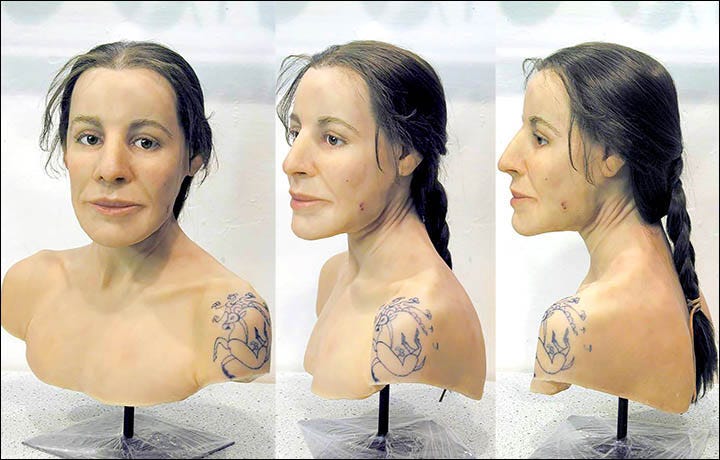
That astonishing discovery opened a window into a forgotten world. Yet despite decades of research, one profound question still lingers: what do we owe the dead when nature unexpectedly returns them to us?

A Discovery Frozen in Time
High in the Altai Mountains of southern Siberia, permanently frozen ground created one of archaeology’s greatest natural vaults. In 1993, archaeologists excavated a burial mound belonging to the ancient Pazyryk culture, revealing the remarkably preserved remains of a young woman often called the Siberian Ice Maiden or the Princess of Ukok.

Estimated to have died around the age of 25 approximately 2,500 years ago, she had been carefully placed inside a carved larch-wood coffin. Nearby rested six saddled horses, suggesting an elaborate burial ceremony that reflected her importance within her community.
But that was only the beginning.
What the Ice Preserved
Tattoos That Defied Time
Perhaps the most extraordinary feature was the artwork still visible on her skin. Her shoulder displayed an elaborate mythical creature combining the beak of a griffin, the head of a deer, and antlers flowing into elegant floral forms.
These tattoos are widely regarded as masterpieces of ancient body art. They also provide rare insight into the symbolism, beliefs, and artistic traditions of Iron Age nomadic societies.
Clothing and Burial Objects
The frozen conditions preserved far more than human remains. Archaeologists recovered clothing made from felt, fur, wool, and imported silk, demonstrating that long-distance trade networks connected communities across Eurasia much earlier than many people imagine.
- A carefully crafted wooden coffin.
- Six fully equipped horses prepared for the afterlife.
- Fine textiles and ceremonial garments.
- Personal belongings that reveal remarkable craftsmanship.
What Archaeologists Know Today
Scientific research has transformed our understanding of the Ice Maiden over the past several decades.
Medical imaging suggests she may have suffered from a serious illness during the final years of her life. While researchers continue to study the evidence, these findings remind us that she was not simply an archaeological treasure, but a real individual who experienced hardship and was deeply mourned by her community.
Evidence from the burial also supports the conclusion that she belonged to the Pazyryk culture, an Iron Age society known for its skilled horsemanship, elaborate animal art, and complex funerary traditions.
The Questions Researchers Still Debate
Was She Really a Princess?
The popular nickname ‘Princess of Ukok’ captures public imagination, but mainstream archaeology does not confirm that she was literally a royal princess.
Some scholars believe she may have been a respected spiritual figure or healer because of the distinctive nature of her burial. Others suggest she occupied an elite social position without necessarily belonging to a royal family.
The available evidence supports several interpretations, but none has been proven conclusively.
What Did Her Tattoos Mean?
The tattoo designs continue to fascinate researchers.
Mainstream interpretations suggest they reflected mythology, identity, spiritual protection, or social status. Because no written records survive from the Pazyryk people, however, the exact meaning remains unknown.
And that unanswered question continues to inspire new research.
Where Evidence Ends and Speculation Begins
Over the years, numerous alternative theories have emerged regarding the Ice Maiden.
- Established evidence: She belonged to the Pazyryk culture, lived about 2,500 years ago, and was preserved by permafrost.
- Mainstream interpretation: Her elaborate burial indicates significant status within her society.
- Alternative hypotheses: She may have served as a spiritual leader, ritual specialist, or healer, though definitive proof is lacking.
- Legends and folklore: Some local traditions attach spiritual significance to her remains, but these beliefs are cultural traditions rather than archaeological evidence.
Why the Discovery Still Matters Today
The Ice Maiden challenges modern assumptions about ancient nomadic cultures.
Far from being isolated groups, the Pazyryk people demonstrated sophisticated artistic traditions, extensive trade connections, advanced craftsmanship, and complex ceremonial practices.
Her discovery also raises difficult ethical questions. Should ancient human remains remain in museums for scientific study, or should they be returned for reburial out of respect for descendant communities and local cultural beliefs?
There is no universally accepted answer.
Modern Technology Continues to Reveal New Clues
Advances in medical imaging, forensic science, and archaeological analysis continue to uncover details that earlier researchers could not observe.
Without disturbing the remains further, scientists have gained deeper insight into her health, lifestyle, and burial practices. Each technological breakthrough adds another piece to the puzzle while reminding researchers how much remains unknown.
Even after decades of study, the frozen Altai Mountains have not revealed every secret.
Final Thoughts
The Siberian Ice Maiden remains one of archaeology’s most captivating discoveries because she bridges two worlds: the scientific pursuit of knowledge and the deeply human story of a young woman whose community honored her with extraordinary care.
Her beautifully preserved tattoos continue to inspire wonder. Her burial continues to provoke questions. And the debate over her final resting place reminds us that archaeology is not only about uncovering the past—it is also about deciding how we should respect it.
Sometimes the greatest mysteries are not about how someone lived, but about how we choose to remember them.
What Readers Are Saying
- Michael Turner: “I’ve read about this discovery before, but this article kept me engaged from beginning to end.”
- Emily Carter: “The balance between science and mystery made this incredibly enjoyable to read.”
- David Brooks: “Those tattoos surviving for 2,500 years are absolutely astonishing.”
- Sarah Mitchell: “I appreciate how the article clearly separated facts from speculation.”
- James Wilson: “Now I want to learn much more about the Pazyryk culture.”
- Olivia Reed: “The ethical questions at the end really made me think.”
Frequently Asked Questions
Is the Siberian Ice Maiden a real historical figure?
Yes. She is a genuine archaeological discovery excavated in 1993 from a Pazyryk burial mound in the Altai Mountains.
Why are her tattoos so well preserved?
Permanent frozen ground protected her body for approximately 2,500 years, allowing soft tissues and tattoos to survive unusually well.
Was she actually a princess?
No definitive evidence confirms that title. It is a popular nickname rather than an established historical fact.
What do archaeologists believe about her role?
Many researchers believe she held an important position within Pazyryk society, though whether she was an elite noble, healer, or ritual specialist remains uncertain.
Has modern technology changed what we know about her?
Yes. Medical imaging and forensic research have provided valuable information about her health, lifestyle, and burial without causing additional damage to the remains.
Why is there debate about her resting place?
Some people support continued scientific study, while others believe she should be reburied out of respect for cultural traditions and the wishes of local communities.