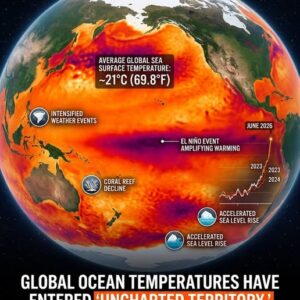
What begins as a subtle rise in ocean temperatures can eventually reshape weather patterns across entire continents. Scientists are now closely watching the Pacific Ocean as climate models suggest that the developing 2026 El Niño could become one of the most significant events in modern history—but how likely is that comparison?

The answer is still unfolding, and while early projections have attracted global attention, researchers emphasize that many important questions remain.

The Climate Pattern Drawing Worldwide Attention
El Niño is a naturally occurring climate phenomenon characterized by unusually warm sea surface temperatures in the central and eastern tropical Pacific Ocean. Although it has occurred throughout recorded history, every event develops differently, making long-term forecasting both challenging and essential.

Recent observations indicate that parts of the Pacific are warming, prompting scientists to monitor whether these conditions will continue strengthening during the coming months. Climate models have explored a range of possible outcomes, including scenarios that resemble some of the strongest historical El Niño episodes.
What Scientists Know So Far
Rising Ocean Temperatures
Satellite observations, ocean buoys, and sophisticated climate models allow researchers to monitor changes in sea surface temperatures with remarkable precision. These measurements provide early clues about whether an El Niño event is likely to develop.
At present, scientists are observing warming trends that deserve close attention, but forecasting several months into the future always involves uncertainty.
How Climate Models Help
Modern forecasting combines decades of historical observations with advanced computer simulations. Instead of predicting a single outcome, researchers evaluate multiple scenarios to estimate how likely different strengths of El Niño may become.
Some model runs have drawn comparisons to the extraordinary 1877 event. However, these comparisons are based on projected ocean conditions rather than certainty that history will repeat itself.
Why the 1877 Event Still Matters
The El Niño of 1877–1878 remains one of the strongest events documented in historical climate records. It coincided with severe droughts, shifting rainfall patterns, agricultural losses, and widespread societal impacts in several regions around the world.
Because global observation systems were limited during the nineteenth century, researchers continue studying historical records to better understand the full extent of that event.
That historical benchmark now serves as an important reference when evaluating modern climate projections.
The Main Scientific Interpretations
Mainstream Climate Research
The prevailing scientific interpretation is that El Niño develops through interactions between the ocean and atmosphere. Changes in trade winds, ocean heat distribution, and atmospheric circulation reinforce one another, producing global weather impacts that vary from event to event.
Researchers stress that while climate change may influence background ocean temperatures, individual El Niño events remain part of Earth’s natural climate variability.
Alternative Perspectives
Some scientists continue investigating whether a warming global climate could increase the intensity or frequency of extreme El Niño episodes. This remains an active area of research rather than an established conclusion.
Current evidence supports continued investigation, but no single explanation fully accounts for every observed pattern.
Potential Global Impacts
If a strong El Niño develops, its effects may extend far beyond the Pacific Ocean.
- Changes in rainfall across Asia, Australia, and the Americas
- Greater risk of drought in some regions
- Increased flooding in others
- Shifts in tropical cyclone activity
- Impacts on agriculture, fisheries, and water resources
- Temporary increases in global average temperatures
Exactly which regions experience these effects—and how severely—depends on how the event evolves over time.
And that is where the greatest uncertainty remains.
Modern Technology Is Changing Climate Forecasting
Today’s scientists have access to tools unimaginable just a few decades ago. Satellites continuously measure ocean temperatures, autonomous floats monitor subsurface conditions, and artificial intelligence is increasingly helping researchers identify subtle climate patterns.
These advances have greatly improved seasonal forecasting, although no model can eliminate uncertainty entirely.
As new observations become available, forecasts are continually updated to reflect the latest evidence.
Why This Story Matters
Understanding El Niño is not simply an academic exercise. Governments, farmers, emergency planners, shipping industries, and energy providers all rely on seasonal climate outlooks when making important decisions.
Even small improvements in forecasting can help communities prepare for floods, droughts, heat waves, and changing agricultural conditions.
Whether the developing event ultimately approaches the strength of 1877 or follows a different path, scientists agree that careful monitoring will be essential throughout 2026.
Final Thoughts
Climate science often advances through careful observation rather than dramatic conclusions. Although comparisons with the historic 1877 El Niño have generated considerable interest, researchers caution that projections are not guarantees.
The coming months will provide crucial new data. Until then, the world’s oceans continue revealing their story—one measurement at a time.
What Readers Are Saying
- Michael Turner: “This explained a complex climate topic in a way that was both clear and fascinating.”
- Emily Carter: “I had no idea scientists could compare modern climate models with events from the 1800s.”
- David Brooks: “The gradual buildup kept me reading all the way through.”
- Sarah Mitchell: “Balanced, informative, and refreshingly free of sensationalism.”
- James Wilson: “Now I understand why El Niño affects weather around the world.”
- Olivia Harris: “Excellent explanation of what scientists know versus what they’re still studying.”
Frequently Asked Questions
Could the 2026 El Niño really become as strong as the 1877 event?
Some climate models have explored that possibility, but scientists emphasize that projections will continue evolving as new data becomes available.
What causes El Niño?
It develops through interactions between warming Pacific Ocean waters and changes in atmospheric circulation, particularly trade winds.
Does climate change cause El Niño?
No. El Niño is a natural climate pattern, although researchers continue studying how long-term global warming may influence its characteristics.
Why is forecasting El Niño so difficult?
Ocean-atmosphere interactions are extremely complex, and small changes can influence how an event develops over many months.
What technologies help scientists monitor El Niño today?
Researchers use satellites, ocean buoys, autonomous floats, climate models, and advanced data analysis to track changing conditions across the Pacific Ocean.